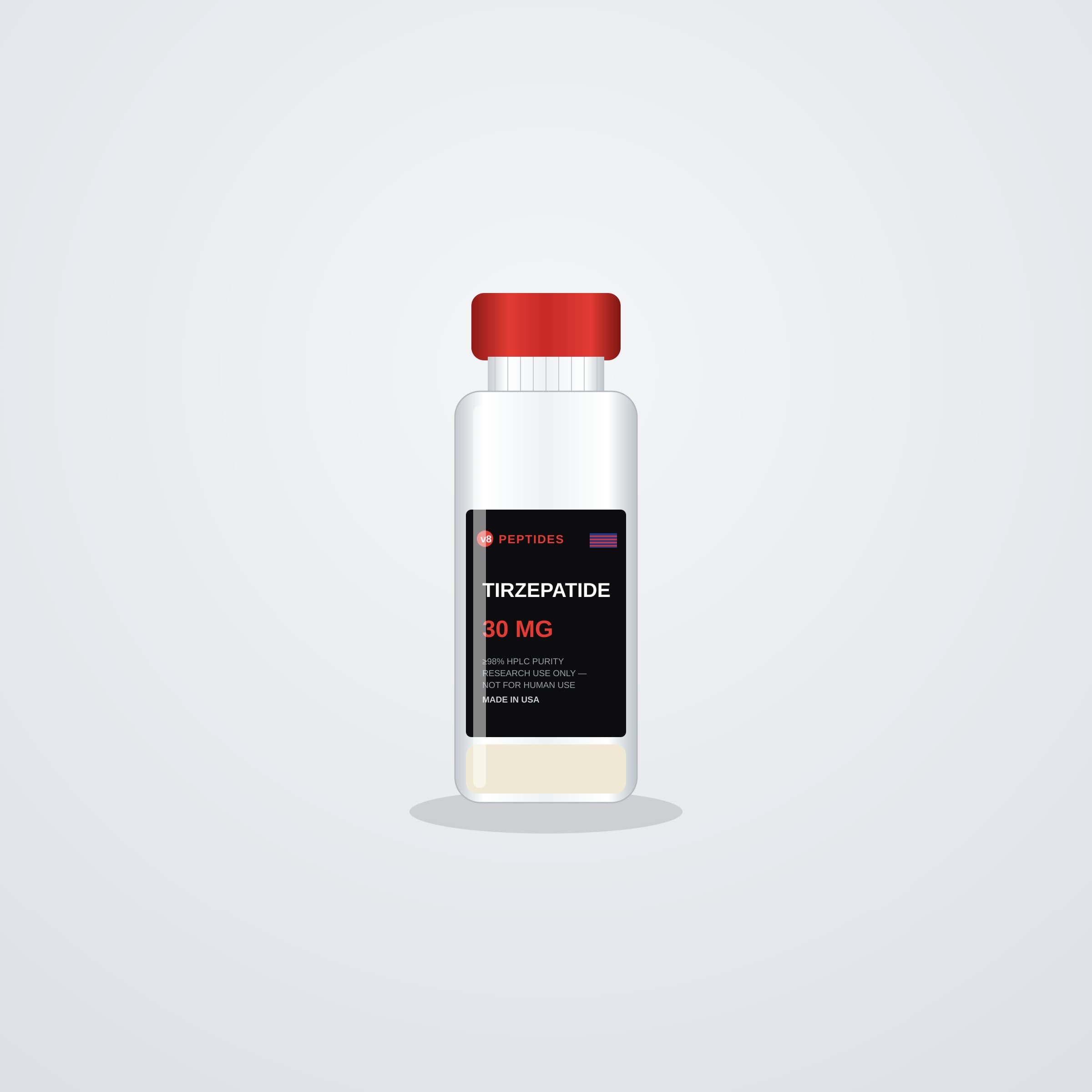
Tirzepatide
Dual GIP / GLP-1 receptor agonist
$190.00
Secure payment by card link, Zelle or crypto · discreet packaging · fast USPS shipping
Dual GLP-1 and GIP receptor agonist engineered for advanced metabolic and lipid research. Supplied as a lyophilized powder with ≥98% HPLC purity verification.
Research applications
- 01Incretin (GIP / GLP-1) receptor signaling
- 02Glucose-regulation research models
- 03Energy-expenditure & lipid-metabolism studies
- Sizes
- 30 mg
- Purity
- ≥98%
- Molecular formula
- C225H348N48O68
- Sequence / identity
- Provided on batch COA
- Supplied form
- Lyophilized powder
- Storage
- Refrigerate at 2–8 °C; −20 °C for long-term. Protect from heat, moisture & light.
- Container
- Sealed clear glass research vial
- ✓Compound identity & sequence
- ✓Measured purity (HPLC %)
- ✓Sequence / identity confirmation
- ✓Batch / lot number
- ✓Analytical test date
- ✓Supplied form & storage
Research Use Only. All products are sold strictly for laboratory research and development purposes only. Not for human or animal consumption. Not a drug, food, or cosmetic. By purchasing, you affirm you are a qualified researcher or institution.
Batch documentation
Batch-specific analytical documentation supports receiving, verification, and internal recordkeeping.
Storage guidance
Refrigerate the supplied material, freeze for long-term storage, and protect it from heat, moisture, and light.
Research-only labeling
Every vial is clearly identified for laboratory research use only — not for human or veterinary use.
What Is Tirzepatide?
Tirzepatide (LY3298176) is a 39-residue synthetic peptide built on the native GIP sequence and engineered to engage two incretin receptors: the GIP receptor and the GLP-1 receptor. Because one molecule drives both pathways, it is often described in the literature as a dual agonist, and it has become a standard tool compound for laboratories that study incretin receptor signaling, biased agonism and glucose-regulation models.
The molecule (molecular formula C225H348N48O68) carries a C20 fatty diacid attached through a linker at a lysine side chain. This lipidation promotes albumin binding and is a well-characterized example of half-life engineering, which is why tirzepatide also turns up in formulation, stability and analytical-chemistry projects. In the lab it is used for receptor-binding experiments, cAMP accumulation assays, comparison against single-receptor GLP-1 agonists, and as a reference standard during method development. V8 Peptides supplies it as a 30 mg lyophilized vial.
Tirzepatide Specifications
| Compound | Tirzepatide (LY3298176) |
|---|---|
| Vial size | 30 mg |
| Purity | ≥98% by HPLC |
| Molecular formula | C225H348N48O68 |
| Class | Dual GIP / GLP-1 receptor agonist |
| Form | Lyophilized powder, sealed clear glass vial |
| Storage | 2–8 °C short term; −20 °C long term |
Reconstitution & Storage for Research
A 30 mg vial holds more peptide than most single-compound vials, so the diluent volume you choose has a large effect on the working concentration. Decide on the stock strength your assay needs first, then work backward to the volume.
Concentration math
- Adding 3 mL of diluent to a 30 mg vial gives 10 mg/mL.
- Adding 2 mL of diluent to a 30 mg vial gives 15 mg/mL.
- Adding 1.5 mL of diluent to a 30 mg vial gives 20 mg/mL.
- Diluting 0.1 mL of a 10 mg/mL stock into 0.9 mL of buffer gives a 1 mg/mL working solution.
The V8 calculator handles these conversions for any volume, and the calculator guide explains each input. When adding diluent, direct the stream against the glass instead of onto the lyophilized cake, then roll or swirl the vial until the solution is clear. Avoid vortexing.
Storage conditions
Store sealed vials in the refrigerator at 2–8 °C, or move them to a −20 °C freezer for long-term holding. Heat, moisture and light all accelerate peptide degradation, so keep vials in their box and away from the freezer door. After reconstitution, keep the solution at 2–8 °C and aliquot it to limit freeze-thaw exposure. More detail is in our tirzepatide storage and stability article.
Quality & Testing
Purity claims are only useful when a lab can check them. Each tirzepatide batch is tested by HPLC against a ≥98% release specification, and the resulting certificate of analysis is tied to the lot number on the vial label.
- Measured HPLC purity for that batch
- Compound identity and sequence confirmation
- Lot number and date of analysis
- Form and recommended storage
You can open the current certificate from the COA library at any time. For background on how the analysis is run and how to read the report, see tirzepatide purity testing.
Related Lab Guides
- Tirzepatide reconstitution and handling
- Tirzepatide storage and stability
- Tirzepatide mechanism of action
- Semaglutide vs. tirzepatide: research comparison
- Where to buy tirzepatide: what to verify
- Tirzepatide chemical structure and synthesis
For laboratory research use only; not for human consumption.
Frequently Asked Questions
What purity is Tirzepatide?+
Tirzepatide is verified to ≥98% purity by HPLC, with identity confirmed by batch-specific analytical documentation (COA) published on our site.
How is Tirzepatide supplied and stored?+
Tirzepatide is supplied as a lyophilized powder. Refrigerate at 2–8 °C, or freeze at −20 °C for long-term storage. Protect from heat, moisture, and light.
Do you provide a Certificate of Analysis?+
Yes — every batch ships with batch-specific analytical documentation (COA) to support qualified receiving and internal recordkeeping.
Is Tirzepatide approved for human use?+
No. This product is sold strictly for laboratory research and development purposes and is not for human or animal consumption.
Related Research
Research Library →
Semaglutide vs. Tirzepatide: Brand Chemistry Comparison
Tirzepatide: Mounjaro & Zepbound Brand Chemistry Reference

Semaglutide vs. Tirzepatide vs. Retatrutide vs. Cagrilintide: 2026 GLP-1 Research Comparison

Tirzepatide Chemical Structure & Synthesis

Tirzepatide: Discovery & Development History