TB-500
Thymosin β4 fragment (17-23)
$75.00
Secure payment by card link, Zelle or crypto · discreet packaging · fast USPS shipping
In stock · ships from the USA via USPS
Also available as a stack
- KLOW Stack$152.00
- Wolverine Stack — BPC-157 + TB-500$124.00
- Glow Stack — GHK-Cu + BPC-157 + TB-500$105.00
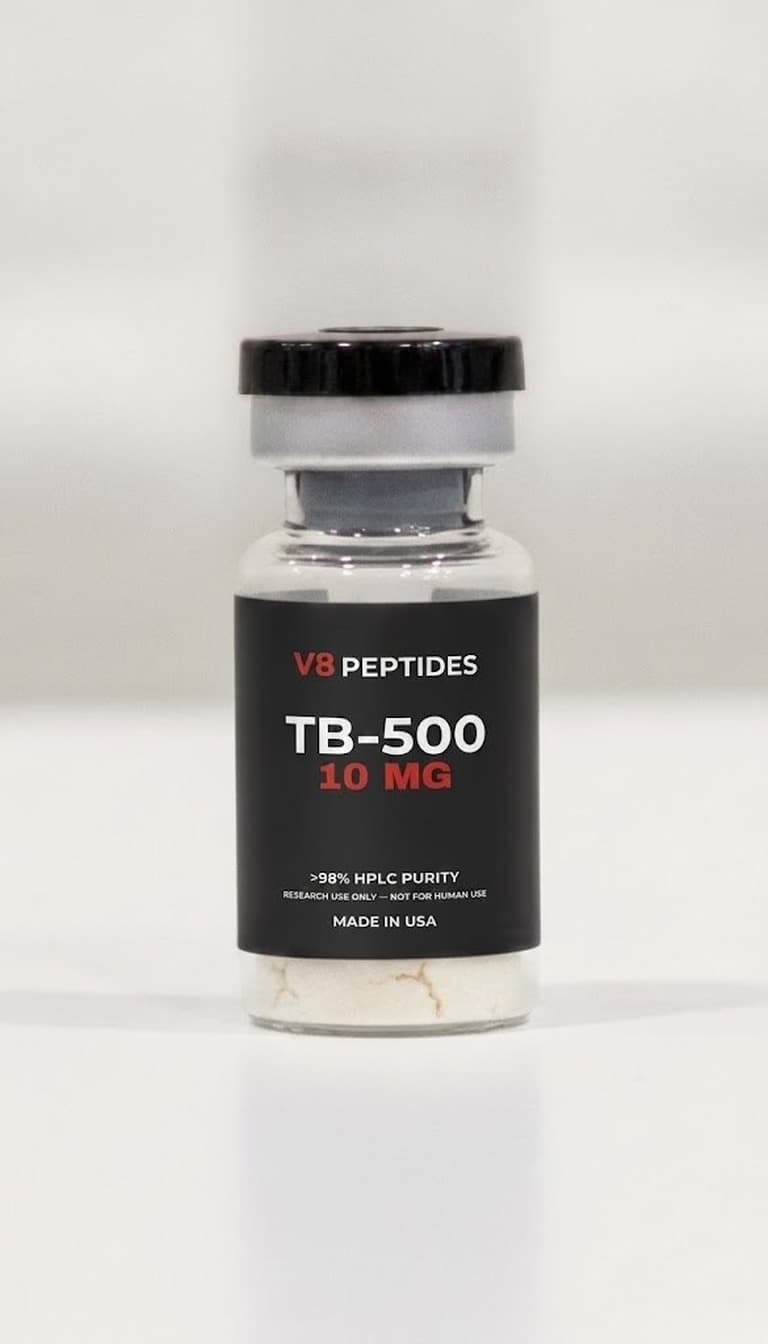
Synthetic 17-23 fragment of Thymosin β4 (Ac-LKKTETQ, about 889 Da), studied for actin regulation, cell migration, and tissue-response mechanisms. ≥98% HPLC purity.
Research applications
- 01Actin-binding / cytoskeletal research
- 02Cell-migration & angiogenesis models
- 03Tissue-response studies
- Sizes
- 10 mg
- Purity
- ≥98%
- Molecular formula
- C38H68N10O14
- Sequence / identity
- Ac-Leu-Lys-Lys-Thr-Glu-Thr-Gln (Ac-LKKTETQ)
- Supplied form
- Lyophilized powder
- Storage
- Refrigerate at 2–8 °C; −20 °C for long-term. Protect from heat, moisture & light.
- Container
- Sealed clear glass research vial
- ✓Compound identity & sequence
- ✓Measured purity (HPLC %)
- ✓Sequence / identity confirmation
- ✓Batch / lot number
- ✓Analytical test date
- ✓Supplied form & storage
Research Use Only. All products are sold strictly for laboratory research and development purposes only. Not for human or animal consumption. Not a drug, food, or cosmetic. By purchasing, you affirm you are a qualified researcher or institution.
Batch documentation
Batch-specific analytical documentation supports receiving, verification, and internal recordkeeping.
Storage guidance
Refrigerate the supplied material, freeze for long-term storage, and protect it from heat, moisture, and light.
Research-only labeling
Every vial is clearly identified for laboratory research use only — not for human or veterinary use.
TB-500 research peptide, 10 mg: a lyophilized synthetic thymosin β4 fragment (acetylated 17–23, Ac-LKKTETQ) in a sealed glass vial, specified at ≥98% purity by HPLC. Certificates of analysis from the independent lab Accumark Labs are published on our COA page as reports come back. Sold for laboratory research use only; ships from Florida by USPS to US addresses.
What Is TB-500?
TB-500 is the laboratory name for a synthetic peptide based on thymosin beta-4 (Tβ4), a small, highly conserved protein found in nearly all nucleated cells. Thymosin beta-4 is best known as the main G-actin-sequestering molecule in the cytoplasm: by holding actin monomers in reserve, it influences how quickly a cell can assemble and remodel its cytoskeleton.
That link to actin dynamics is what makes TB-500 interesting to researchers. The peptide is used in cytoskeletal and actin-binding studies, in scratch and transwell cell-migration assays, in angiogenesis models such as endothelial tube formation, and in broader tissue-response research in vitro and in animal models. It is also studied side by side with other peptides to separate overlapping signaling pathways. V8 Peptides supplies TB-500 as a lyophilized powder in a 10 mg research vial.
TB-500 Specifications
| Compound | TB-500 (thymosin beta-4 derived peptide) |
|---|---|
| Vial sizes | 10 mg |
| Purity | ≥98% by HPLC |
| Research area | Actin regulation, cell migration, angiogenesis models |
| Identity | Sequence confirmation reported on the certificate of analysis, where published |
| Form | Lyophilized powder, sealed clear glass vial |
| Storage | 2–8 °C short term; −20 °C long term |
Reconstitution & Storage for Research
Confirm the vial size on the bench before calculating. The relationship is always the same: milligrams of peptide divided by milliliters of diluent equals the stock concentration.
Concentration math
- Adding 2 mL of diluent to a 10 mg vial gives 5 mg/mL.
- Adding 1 mL of diluent to a 10 mg vial gives 10 mg/mL.
Choosing a target concentration up front (for example, 5 mg/mL from a 10 mg vial) keeps pipetting volumes consistent between experiments. The calculator will confirm any combination. To dissolve the powder, add diluent gently down the side of the vial and rotate it slowly; TB-500 normally goes into solution within a minute or two without agitation.
Storage conditions
Lyophilized TB-500 should be refrigerated at 2–8 °C on arrival and frozen at −20 °C if it will not be used soon. Keep vials sealed, dry and out of the light. Peptides containing methionine are prone to oxidation, so minimize the time a reconstituted stock spends at room temperature, store it at 2–8 °C, and aliquot to avoid repeated freeze-thaw cycles. Full details are in TB-500 reconstitution and storage.
Quality & Testing
TB-500 is supplied to a ≥98% purity specification. No lab report is published for TB-500 on its own yet; reports for our blends that contain it are on the COA page.
- Measured purity by HPLC
- Compound identity and sequence confirmation
- Lot code of the tested sample
- Test date, supplied form and storage conditions
Reports are posted on the COA page as they come back. Our article on TB-500 purity testing describes how HPLC and identity methods complement each other.
Mechanism and Research Use
Thymosin β4 is a 43-amino-acid protein and the major actin-sequestering molecule in eukaryotic cells. A review of its active sites reports that a short sequence containing LKKTETQ, the central actin-binding domain (residues 17–23) plus one further residue, promotes angiogenesis, wound healing and cell migration, while other regions are linked to anti-inflammatory and cell-survival activity (reference 1). TB-500 is the acetylated 17–23 fragment, Ac-LKKTETQ (C38H68N10O14, 889.02 g/mol), not full-length thymosin β4.
In a 2026 rat Achilles-tendon study, the TB-500 group had significantly higher maximum load to failure than controls and significantly lower Bonar and Movin histology scores (reference 2). That is animal data only.
- Scratch-wound and transwell cell-migration assays
- Actin-binding and cytoskeleton studies
- Endothelial tube-formation and angiogenesis models
- Comparison with BPC-157 or as part of a blend, see the BPC-157 + TB-500 stack
Shipping, Handling & Returns
Vials are produced in South Carolina and shipped from Florida by USPS to addresses in the United States only. Each vial travels sealed in its original glass container. If an order arrives damaged or incorrect, contact us within 48 hours of delivery and we will arrange a replacement or a refund to the original payment method. Questions go to the support address in the site footer.
TB-500 Research FAQ
What is TB-500?
The acetylated 17–23 fragment of thymosin β4, Ac-LKKTETQ, a 7-residue peptide. It is not the full 43-residue thymosin β4 protein. Sold as a 10 mg lyophilized research vial for laboratory use only.
Is there a lab report for TB-500?
Certificates of analysis from the independent lab Accumark Labs (HPLC purity and identity, measured quantity, and for most lots endotoxin and a PCR sterility screen) are published on the COA page as reports come back. This product does not have a published report yet; the release specification is ≥98% purity by HPLC. Contact us for the status of a specific lot. Lab reports for our blends that contain TB-500 (the 17–23 fragment) are on the COA page.
How do I make a stock solution?
Concentration is mg divided by mL: 2 mL added to the 10 mg vial gives 5 mg/mL. The reconstitution calculator covers other volumes.
How should TB-500 be stored?
Keep the sealed vial at 2–8 °C for short-term holding or at −20 °C for long-term storage, dry and protected from light. Divide reconstituted stock into aliquots and keep it refrigerated to avoid repeated freeze-thaw cycles.
Is TB-500 the same as thymosin beta-4?
No. Thymosin β4 is the full 43-residue protein; TB-500 is a short fragment of it that contains the actin-binding region. The two are separate research compounds.
Do you ship outside the United States?
No. Orders ship from Florida by USPS to United States addresses only. A damaged or incorrect order is replaced or refunded to the original payment method.
References
- Sosne G, Qiu P, Goldstein AL, Wheater M. Biological activities of thymosin beta4 defined by active sites in short peptide sequences. FASEB J. 2010;24(7):2144-2151. PubMed 20179146
- Biçer O, Adanir O, Güleryüz Y, et al. Effects of BPC-157 and TB-500 on Achilles tendon healing in rats: a histopathological and biomechanical study. Jt Dis Relat Surg. 2026;37:822-837. PubMed 42542926
Related Lab Guides
- TB-500 reconstitution and storage
- TB-500 research overview
- TB-500 vs thymosin beta-4: differences
- TB-500 in angiogenesis research
- BPC-157 vs. TB-500
- Where to buy TB-500 for research
- TB-500: Actin-Binding Motif and Cell Migration Assays
- TB-500 and Thymosin β4 Wound Healing Animal Studies
- How to Reconstitute TB-500: A Laboratory Guide
- TB-500 Preclinical Studies: Fragment vs Thymosin Beta-4
- History of TB-500 and Thymosin β4 Research
- TB-500 Laboratory Safety and Handling Guide
- TB-500 Research Questions, Answered With Sources
- TB-500 Mechanism: When Thymosin β4 Knockouts Disagree
- TB-500 Muscle and Ligament Animal Studies: Endpoints
- What Is TB-500? Decoding the Name, Sequence and Mass
For laboratory research use only; not for human consumption.
Customer reviews
1 verified-buyer review · average 5.0 / 5
Quick Answers
What purity is TB-500?+
TB-500 is specified at ≥98% purity by HPLC. A certificate of analysis for this product is not published on our site yet; see the COA page for the reports that are available.
How is TB-500 supplied and stored?+
TB-500 is supplied as a lyophilized powder. Refrigerate at 2–8 °C, or freeze at −20 °C for long-term storage. Protect from heat, moisture, and light.
Do you provide a Certificate of Analysis?+
Certificates of Analysis from our independent lab are published for tested lots (see the COA page), and we add more as reports come back. Contact us for the status of a specific product or lot.
Is TB-500 approved for human use?+
No. This product is sold strictly for laboratory research and development purposes and is not for human or animal consumption.
Related Research
Research Library →
What Is TB-500? Decoding the Name, Sequence and Mass

TB-500 Muscle and Ligament Animal Studies: Endpoints

TB-500 Mechanism: When Thymosin β4 Knockouts Disagree
TB-500: Actin-Binding Motif and Cell Migration Assays
TB-500: Angiogenesis and Cell Migration Assay Guide