
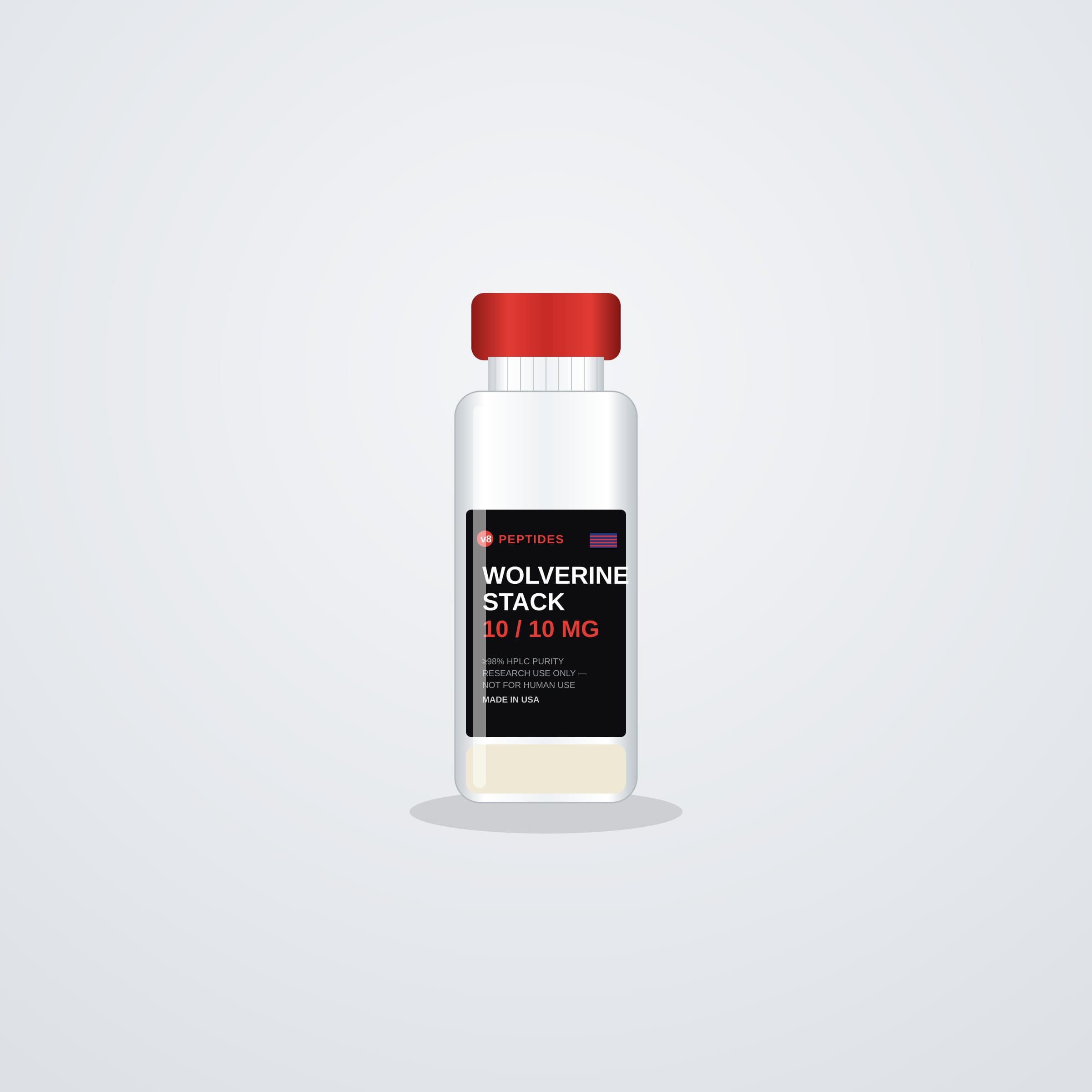
Wolverine Stack — BPC-157 + TB-500
BPC-157 + TB-500 paired research blend
$135.00
Secure payment by card link, Zelle or crypto · discreet packaging · fast USPS shipping
In stock · ships from the USA via USPS
Synergistic research blend combining BPC-157 and Thymosin Beta-4 (TB-500) for paired cell-migration and extracellular-matrix signaling research.
Research applications
- 01Tissue-response research models
- 02Cell-migration studies
- 03Cell-signaling pathway research
- Sizes
- 10 mg / 10 mg
- Purity
- ≥98%
- Sequence / identity
- Reported on the certificate of analysis, where published
- Supplied form
- Lyophilized powder
- Storage
- Refrigerate at 2–8 °C; −20 °C for long-term. Protect from heat, moisture & light.
- Container
- Sealed clear glass research vial
- ✓Compound identity & sequence
- ✓Measured purity (HPLC %)
- ✓Sequence / identity confirmation
- ✓Batch / lot number
- ✓Analytical test date
- ✓Supplied form & storage
Research Use Only. All products are sold strictly for laboratory research and development purposes only. Not for human or animal consumption. Not a drug, food, or cosmetic. By purchasing, you affirm you are a qualified researcher or institution.
Batch documentation
Batch-specific analytical documentation supports receiving, verification, and internal recordkeeping.
Storage guidance
Refrigerate the supplied material, freeze for long-term storage, and protect it from heat, moisture, and light.
Research-only labeling
Every vial is clearly identified for laboratory research use only — not for human or veterinary use.
What Is the Wolverine Stack?
"Wolverine Stack" is the common laboratory nickname for a two-peptide blend of BPC-157 and TB-500. V8 Peptides supplies it as a single co-lyophilized vial containing 10 mg of each compound, 20 mg of peptide in total.
The two components come from different areas of the literature. BPC-157 is a 15-amino-acid synthetic peptide whose sequence matches part of a protein identified in gastric juice; it is studied in models of extracellular-matrix signaling and connective and gastrointestinal tissue biology. TB-500 is a synthetic peptide derived from thymosin beta-4, the principal actin-sequestering protein in mammalian cells, and is used in cell-migration and angiogenesis assays.
Because the proposed mechanisms do not overlap much, the pair is frequently run together in tissue-response and cell-signaling research models, with each single peptide included as a control arm. A pre-blended vial gives such combination studies a fixed 1:1 mass ratio and removes one weighing and mixing step from the protocol.
Wolverine Stack Specifications
| Contents | BPC-157 10 mg + TB-500 10 mg |
|---|---|
| Total peptide | 20 mg per vial (1:1 ratio) |
| Purity | ≥98% by HPLC |
| Identity | Sequence confirmation reported on the certificate of analysis, where published |
| Form | Co-lyophilized powder, sealed clear glass vial |
| Storage | 2–8 °C short term; −20 °C long term |
Reconstitution & Storage for Research
With a blend, there are two concentrations to track: the total peptide concentration and the concentration of each component. In a 1:1 vial the per-component figure is simply half the total.
Concentration math
- Adding 2 mL of diluent to the 10 mg / 10 mg vial gives 5 mg/mL of BPC-157 and 5 mg/mL of TB-500 (10 mg/mL total peptide).
- Adding 1 mL of diluent gives 10 mg/mL of each component (20 mg/mL total).
- Adding 4 mL of diluent gives 2.5 mg/mL of each component (5 mg/mL total).
Write both numbers on the vial label so nobody on the team has to guess later. The calculator can be run once per component using 10 mg as the vial content. Introduce the diluent slowly against the inner wall, let the cake hydrate, and swirl; do not shake. Our BPC-157 + TB-500 blend reconstitution guide walks through the sequence in full.
Storage conditions
Keep the sealed vial at 2–8 °C, or at −20 °C for long-term storage, and protect it from heat, moisture and light. A blend is only as stable as its least stable component, so handle the reconstituted solution conservatively: refrigerate it promptly, keep it away from direct light, and divide it into aliquots when the experiment runs over several days.
Quality & Testing
Blends ask more of an analytical lab than single compounds do, because each peptide has to be resolved and accounted for. The Wolverine Stack is supplied to a ≥98% purity specification, and the certificate for the tested lot is published on the COA page.
- HPLC purity result for the batch
- Identity confirmation for the component peptides
- Lot number and analytical test date
- Supplied form and storage conditions
Certificates are published on the COA page, where you can match the lot on your vial to its report. New to reading these documents? Start with how to read a COA.
Related Lab Guides
- BPC-157 + TB-500 blend reconstitution
- BPC-157 and TB-500 combination research
- BPC-157 vs. TB-500: how the two differ
- Peptide blends and research stacks
- Bacteriostatic water explained
- Reconstitution calculator guide
For laboratory research use only; not for human consumption.
Frequently Asked Questions
What purity is Wolverine Stack — BPC-157 + TB-500?+
Wolverine Stack — BPC-157 + TB-500 is verified to ≥98% purity by HPLC, with identity confirmed by batch-specific analytical documentation (COA) published on our site.
How is Wolverine Stack — BPC-157 + TB-500 supplied and stored?+
Wolverine Stack — BPC-157 + TB-500 is supplied as a lyophilized powder. Refrigerate at 2–8 °C, or freeze at −20 °C for long-term storage. Protect from heat, moisture, and light.
Do you provide a Certificate of Analysis?+
Certificates of Analysis from our independent lab are published for tested lots (see the COA page), and we add more as reports come back. Contact us for the status of a specific product or lot.
Is Wolverine Stack — BPC-157 + TB-500 approved for human use?+
No. This product is sold strictly for laboratory research and development purposes and is not for human or animal consumption.
Related Research
Research Library →
Best Research Peptide Stacks 2026: Combination Rationale, Coverage, and Comparison

BPC-157 & TB-500 Combination Research: Study Design Guide

Peptide Blends & Research Stacks: How Combinations Are Studied
BPC-157 Purity Testing: HPLC, Mass Spec and COA Explained

BPC-157 Research Guide: Structure, Mechanism, Preclinical Findings and Handling
