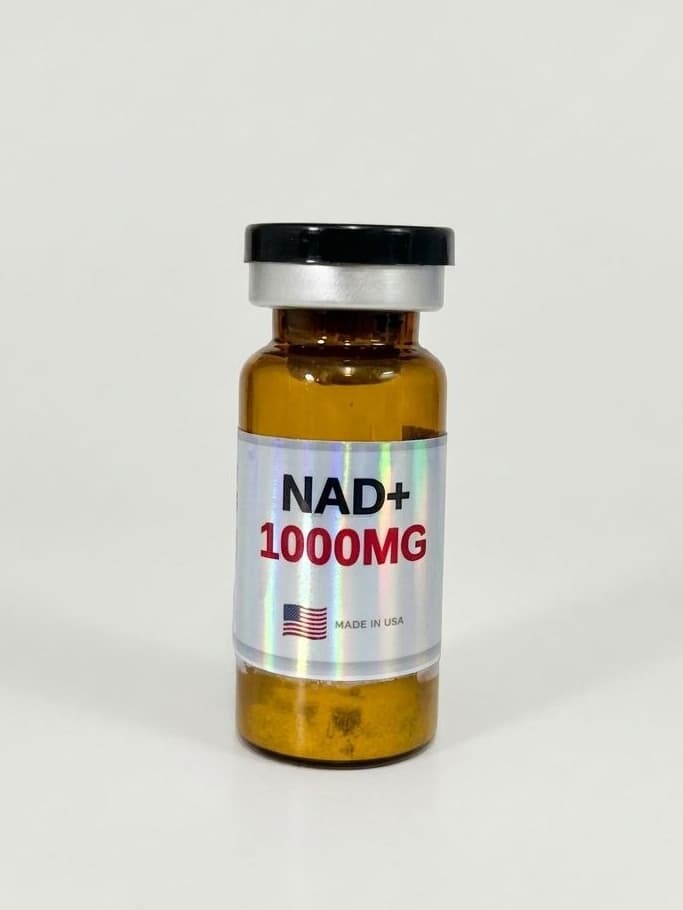
NAD+ 1000 mg
Nicotinamide adenine dinucleotide
$110.00
Secure payment by card link, Zelle or crypto · discreet packaging · fast USPS shipping
Essential coenzyme required for cellular energy metabolism, mitochondrial function, and sirtuin pathway research.
Research applications
- 01Cellular-energy metabolism
- 02Mitochondrial-function research
- 03Sirtuin-pathway & DNA-repair studies
- Sizes
- 1000 mg
- Purity
- ≥98%
- Molecular formula
- C21H27N7O14P2
- Supplied form
- Lyophilized powder
- Storage
- Refrigerate at 2–8 °C; −20 °C for long-term. Protect from heat, moisture & light.
- Container
- Sealed clear glass research vial
- ✓Compound identity & sequence
- ✓Measured purity (HPLC %)
- ✓Molecular identity confirmation
- ✓Batch / lot number
- ✓Analytical test date
- ✓Supplied form & storage
Research Use Only. All products are sold strictly for laboratory research and development purposes only. Not for human or animal consumption. Not a drug, food, or cosmetic. By purchasing, you affirm you are a qualified researcher or institution.
Batch documentation
Batch-specific analytical documentation supports receiving, verification, and internal recordkeeping.
Storage guidance
Refrigerate the supplied material, freeze for long-term storage, and protect it from heat, moisture, and light.
Research-only labeling
Every vial is clearly identified for laboratory research use only — not for human or veterinary use.
What is NAD+?
NAD+ (nicotinamide adenine dinucleotide, oxidized form) is a coenzyme found in every living cell. Unlike most items in our catalog it is not a peptide: it is a dinucleotide, built from two nucleotides, one carrying adenine and the other nicotinamide, joined through their phosphate groups. Its molecular weight is about 663 g/mol.
Biochemically, NAD+ cycles between oxidized (NAD+) and reduced (NADH) forms as it carries electrons in redox reactions, and it is consumed as a substrate by enzyme families including sirtuins and PARPs. Those two roles explain its place in the lab: as a cofactor in dehydrogenase assays and as a variable in cellular-metabolism experiments. V8 Peptides supplies it as lyophilized powder in a 1000 mg vial.
Where it is used in the lab
- Cofactor for dehydrogenase and other enzymatic assays
- Sirtuin and PARP substrate studies
- Cellular energy-metabolism and mitochondrial-function experiments
For laboratory research use only; not for human consumption.
NAD+ specifications
| Compound | NAD+ (nicotinamide adenine dinucleotide) |
|---|---|
| Class | Dinucleotide coenzyme (non-peptide) |
| Vial size | 1000 mg |
| Molecular formula | C21H27N7O14P2 |
| Purity | ≥98% (HPLC) |
| Supplied form | Lyophilized powder, sealed glass vial |
| Storage | 2–8 °C; −20 °C long-term; protect from heat, moisture and light |
| Documentation | Batch-specific COA |
Reconstitution & storage for research
A 1000 mg vial produces concentrated stocks. Adding 10 mL of diluent gives 100 mg/mL; adding 5 mL gives 200 mg/mL. Check the working volume of the vial before choosing, and transfer to a larger sterile container if your target concentration needs more diluent than the vial holds. At 100 mg/mL, a 100 µL aliquot contains 10 mg. For other volumes, the reconstitution calculator returns mg/mL and per-aliquot content instantly.
A sterile diluent such as bacteriostatic water is the usual choice for multi-use research vials. Let the diluent trickle down the vial wall, give the powder time to wet, and roll the vial between your fingers until no particles remain. Avoid shaking or vortexing at high speed. NAD+ is markedly less stable in solution than as dry powder, and it degrades faster with heat, light and alkaline pH, so prepare stocks close to the time of use.
Storage conditions
- Dry material: refrigerated (2–8 °C) on arrival; frozen (−20 °C) when it will not be used soon.
- Handling: limit exposure to warmth, moisture and light, and wipe the stopper with an alcohol swab before each puncture.
- Reconstituted material: store at 2–8 °C, note the date and mg/mL value in your lab record, and freeze single-use aliquots rather than refreezing one vial.
Quality & testing
Purity for NAD+ is measured by HPLC on a per-batch basis, with a ≥98% release threshold. The matching Certificate of Analysis is posted at /coa, which lets a lab verify what it received instead of relying on a generic specification sheet.
- Chromatographic purity (HPLC %)
- Identity check for the stated compound
- Lot number and test date for traceability
- Form supplied and recommended storage
Each sealed vial carries research-use labeling and ships domestically in the US. Orders are paid by invoice or Zelle.
Related lab guides
- NAD+ reconstitution and storage
- How NAD+ purity is tested
- NAD+ chemical structure and synthesis
- NAD+ vs. NMN vs. NR: research comparison
- NAD+ in cellular and metabolic research
- Reconstitution calculator guide
Often ordered together for metabolism-focused projects: MOTS-c, Bacteriostatic water 10 mL.
Frequently Asked Questions
What purity is NAD+ 1000 mg?+
NAD+ 1000 mg is verified to ≥98% purity by HPLC, with identity confirmed by batch-specific analytical documentation (COA) published on our site.
How is NAD+ 1000 mg supplied and stored?+
NAD+ 1000 mg is supplied as a lyophilized powder. Refrigerate at 2–8 °C, or freeze at −20 °C for long-term storage. Protect from heat, moisture, and light.
Do you provide a Certificate of Analysis?+
Yes — every batch ships with batch-specific analytical documentation (COA) to support qualified receiving and internal recordkeeping.
Is NAD+ 1000 mg approved for human use?+
No. This product is sold strictly for laboratory research and development purposes and is not for human or animal consumption.