
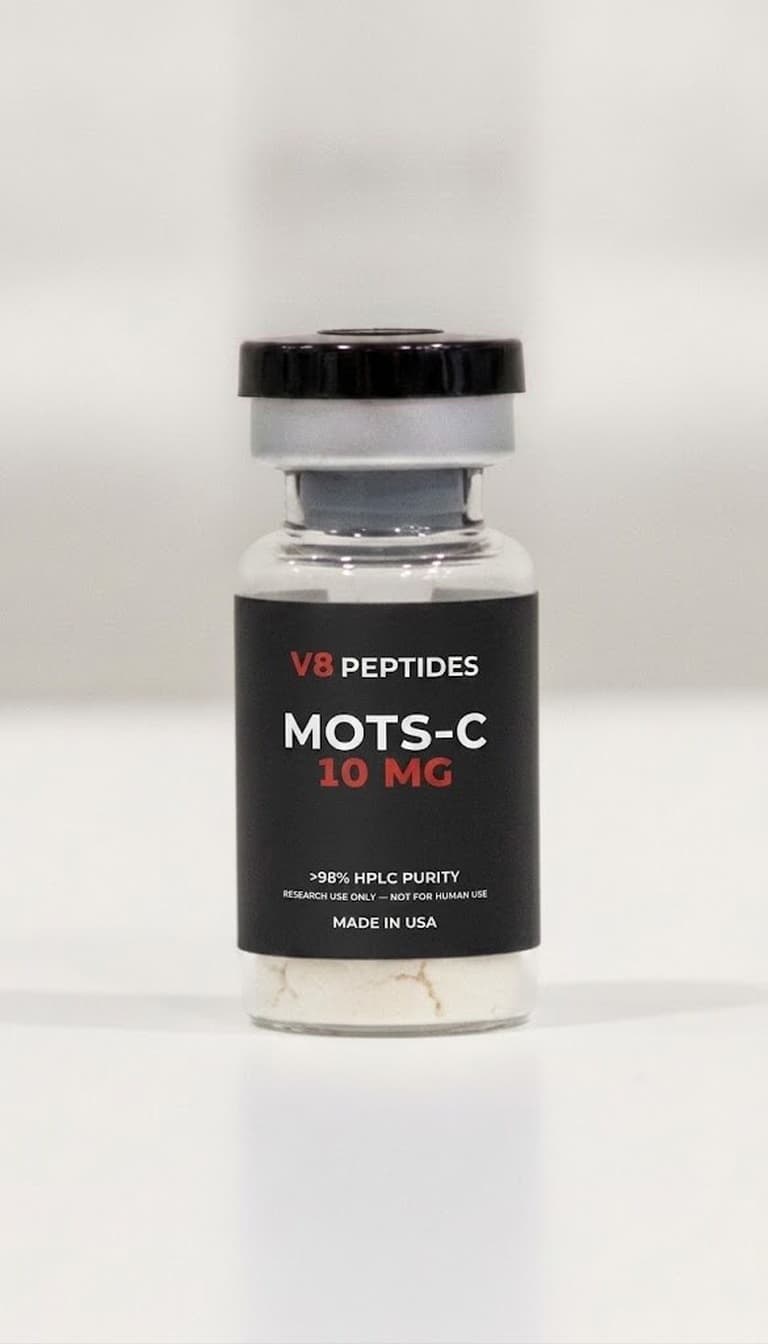
MOTS-c
Mitochondrial-derived peptide
$55.00
Secure payment by card link, Zelle or crypto · discreet packaging · fast USPS shipping
In stock · ships from the USA via USPS
Mitochondrial-derived peptide encoded in the 12S rRNA studied for metabolic-homeostasis and AMPK-signaling research. ≥98% HPLC purity.
Research applications
- 01AMPK-pathway research
- 02Mitochondrial metabolism models
- 03Metabolic-homeostasis studies
- Sizes
- 10 mg
- Purity
- ≥98%
- Molecular formula
- C101H152N28O22S2
- Sequence / identity
- Met-Arg-Trp-Gln-Glu-Met-Gly-Tyr-Ile-Phe-Tyr-Pro-Arg-Lys-Leu-Arg
- Supplied form
- Lyophilized powder
- Storage
- Refrigerate at 2–8 °C; −20 °C for long-term. Protect from heat, moisture & light.
- Container
- Sealed clear glass research vial
- ✓Compound identity & sequence
- ✓Measured purity (HPLC %)
- ✓Sequence / identity confirmation
- ✓Batch / lot number
- ✓Analytical test date
- ✓Supplied form & storage
Research Use Only. All products are sold strictly for laboratory research and development purposes only. Not for human or animal consumption. Not a drug, food, or cosmetic. By purchasing, you affirm you are a qualified researcher or institution.
Batch documentation
Batch-specific analytical documentation supports receiving, verification, and internal recordkeeping.
Storage guidance
Refrigerate the supplied material, freeze for long-term storage, and protect it from heat, moisture, and light.
Research-only labeling
Every vial is clearly identified for laboratory research use only — not for human or veterinary use.
What is MOTS-c?
MOTS-c is a 16-amino-acid peptide encoded by a short open reading frame inside the mitochondrial 12S rRNA gene. First reported in 2015, it belongs to the small group of mitochondrial-derived peptides, alongside humanin, whose coding sequences sit in the mitochondrial genome instead of the nuclear one.
In the laboratory, synthetic MOTS-c is used to study how a mitochondrially encoded signal interacts with cellular energy sensing. Much of the published work examines AMPK-pathway activity and metabolic homeostasis in cultured cells and rodent models. V8 Peptides supplies the peptide as lyophilized powder in a 10 mg vial.
Where it is used in the lab
- AMPK-pathway signaling assays in cell culture
- Mitochondrial metabolism and nuclear cross-talk studies
- Metabolic-homeostasis experiments in preclinical models
For laboratory research use only; not for human consumption.
MOTS-c specifications
| Compound | MOTS-c |
|---|---|
| Class | 16-amino-acid mitochondrial-derived peptide |
| Vial size | 10 mg |
| Molecular formula | C101H152N28O22S2 |
| Purity | ≥98% (HPLC) |
| Supplied form | Lyophilized powder, sealed glass vial |
| Storage | 2–8 °C; −20 °C long-term; protect from heat, moisture and light |
| Documentation | Batch-specific COA |
Reconstitution & storage for research
Adding 2 mL of diluent to the 10 mg vial gives 5 mg/mL; adding 1 mL gives 10 mg/mL for a more concentrated stock. At 5 mg/mL, a 100 µL aliquot contains 500 µg and a 200 µL aliquot contains 1 mg. Our reconstitution calculator runs the same arithmetic for any vial size and diluent volume.
A sterile diluent such as bacteriostatic water is the usual choice for multi-use research vials. Direct the diluent slowly down the inside wall of the vial instead of onto the powder, then swirl gently until the solution is clear. Do not shake; vigorous agitation can foam or shear the material. The sequence includes two methionine residues, which are prone to oxidation, so keep solutions cold and limit air exposure.
Storage conditions
- Unopened vial: refrigerate at 2–8 °C; move to −20 °C if the vial will sit for an extended period.
- Environment: keep the powder away from heat, moisture and direct light, and let a cold vial reach room temperature before opening so condensation does not form inside.
- After reconstitution: return the solution to 2–8 °C, label it with concentration and preparation date, and split it into aliquots if it will be sampled more than a few times.
Quality & testing
MOTS-c is supplied to a specification of ≥98% purity by HPLC. The result is recorded on a batch-specific Certificate of Analysis, published on our COA page, so you can match the lot number on the vial to the document before the material enters your workflow.
- Measured HPLC purity, reported as a percentage
- Identity confirmation for the compound
- Batch / lot number and analytical test date
- Supplied form and storage conditions
Vials are sealed, labeled for research use and shipped within the United States in discreet packaging. Payment is by invoice, Zelle or crypto.
Related lab guides
- MOTS-c research overview
- MOTS-c reconstitution and storage
- How MOTS-c purity is tested
- MOTS-c chemical structure and synthesis
- MOTS-c vs. other mitochondrial-derived peptides
- Reconstitution calculator guide
Other compounds used in cellular-metabolism research: NAD+ 1000 mg, AOD-9604.
Frequently Asked Questions
What purity is MOTS-c?+
MOTS-c is verified to ≥98% purity by HPLC, with identity confirmed by batch-specific analytical documentation (COA) published on our site.
How is MOTS-c supplied and stored?+
MOTS-c is supplied as a lyophilized powder. Refrigerate at 2–8 °C, or freeze at −20 °C for long-term storage. Protect from heat, moisture, and light.
Do you provide a Certificate of Analysis?+
Certificates of Analysis from our independent lab are published for tested lots (see the COA page), and we add more as reports come back. Contact us for the status of a specific product or lot.
Is MOTS-c approved for human use?+
No. This product is sold strictly for laboratory research and development purposes and is not for human or animal consumption.
Related Research
Research Library →
What Is MOTS-c? A Plain-Language Research Explainer

MOTS-c vs. Other Mitochondrial-Derived Peptides: A Research Comparison
MOTS-c Purity Testing: HPLC & Mass-Spec Identity Verification
How to Reconstitute and Store MOTS-c: Lab Best Practices
MOTS-c Research Guide: Structure, Mechanism, Preclinical Findings and Handling