GHK-Cu
Copper tripeptide-1
$40.00
Size
Secure payment by card link, Zelle or crypto · discreet packaging · fast USPS shipping
Naturally occurring copper tripeptide studied for collagen synthesis, dermal restructuring, and gene expression remodeling.
Research applications
- 01Collagen-synthesis research models
- 02Dermal-remodeling studies
- 03Gene-expression research
- Sizes
- 50 mg · 100 mg
- Purity
- ≥98%
- Sequence / identity
- Gly-His-Lys (copper-bound)
- Supplied form
- Lyophilized powder
- Storage
- Refrigerate at 2–8 °C; −20 °C for long-term. Protect from heat, moisture & light.
- Container
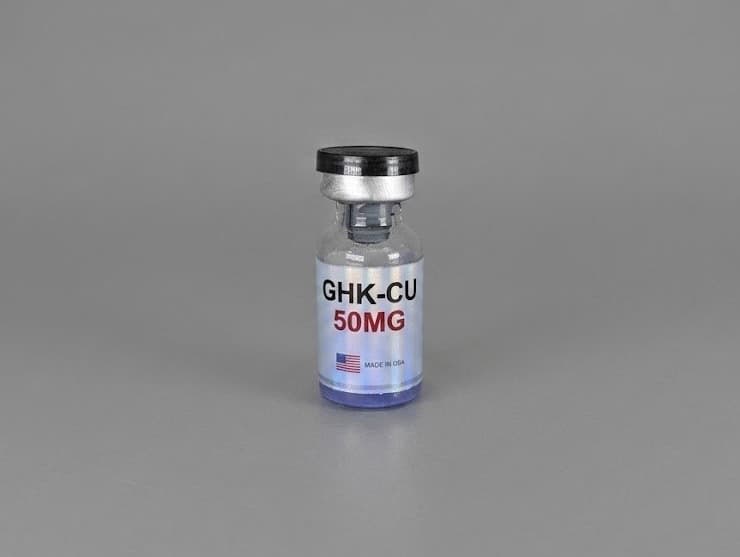
- Sealed clear glass research vial
- ✓Compound identity & sequence
- ✓Measured purity (HPLC %)
- ✓Sequence / identity confirmation
- ✓Batch / lot number
- ✓Analytical test date
- ✓Supplied form & storage
Research Use Only. All products are sold strictly for laboratory research and development purposes only. Not for human or animal consumption. Not a drug, food, or cosmetic. By purchasing, you affirm you are a qualified researcher or institution.
Batch documentation
Batch-specific analytical documentation supports receiving, verification, and internal recordkeeping.
Storage guidance
Refrigerate the supplied material, freeze for long-term storage, and protect it from heat, moisture, and light.
Research-only labeling
Every vial is clearly identified for laboratory research use only — not for human or veterinary use.
What is GHK-Cu?
GHK-Cu is the copper(II) complex of the tripeptide glycyl-L-histidyl-L-lysine (Gly-His-Lys). The peptide was first isolated from human plasma in the 1970s and binds copper with high affinity; the bound metal is what gives the lyophilized powder and its solutions their characteristic blue color. Ingredient nomenclature lists the same complex as copper tripeptide-1.
In research settings, GHK-Cu is used mainly in cell-culture work: fibroblast studies of extracellular-matrix proteins such as collagen, gene-expression profiling, and experiments on copper binding and transport. V8 Peptides supplies it as lyophilized powder in 50 mg and 100 mg vials, sizes suited to labs that run repeated culture experiments from one lot.
Where it is used in the lab
- Collagen and extracellular-matrix expression studies in fibroblast cultures
- Gene-expression profiling in dermal cell models
- Copper-binding and metal-transport experiments
For laboratory research use only; not for human consumption.
GHK-Cu specifications
| Compound | GHK-Cu (copper tripeptide-1) |
|---|---|
| Class | Tripeptide–copper(II) complex |
| Sequence | Gly-His-Lys, copper-bound |
| Vial sizes | 50 mg · 100 mg |
| Purity | ≥98% (HPLC) |
| Supplied form | Lyophilized powder, sealed glass vial |
| Storage | 2–8 °C; −20 °C long-term; protect from heat, moisture and light |
| Documentation | Batch-specific COA |
Reconstitution & storage for research
GHK-Cu dissolves readily in aqueous diluent, and a blue solution is the expected appearance. Adding 2.5 mL of diluent to the 50 mg vial gives 20 mg/mL; the same 2.5 mL in the 100 mg vial gives 40 mg/mL. For a 10 mg/mL working stock from the 50 mg vial, dilute a measured portion 1:1 in a second sterile container. At 20 mg/mL, a 100 µL aliquot contains 2 mg. Our reconstitution calculator runs the same arithmetic for any vial size and diluent volume.
A sterile diluent such as bacteriostatic water is the usual choice for multi-use research vials. Direct the diluent slowly down the inside wall of the vial instead of onto the powder, then swirl gently until the solution is clear. Do not shake; vigorous agitation can foam or shear the material.
Storage conditions
- Unopened vial: refrigerate at 2–8 °C; move to −20 °C if the vial will sit for an extended period.
- Environment: keep the powder away from heat, moisture and direct light, and let a cold vial reach room temperature before opening so condensation does not form inside.
- After reconstitution: return the solution to 2–8 °C, label it with concentration and preparation date, and split it into aliquots if it will be sampled more than a few times.
Quality & testing
Every lot of GHK-Cu is analyzed by high-performance liquid chromatography (HPLC) before release, against a specification of ≥98% purity. The result is recorded on a batch-specific Certificate of Analysis, published on our COA page, so you can match the lot number on the vial to the document before the material enters your workflow.
- Measured HPLC purity, reported as a percentage
- Identity confirmation for the compound
- Batch / lot number and analytical test date
- Supplied form and storage conditions
Vials are sealed, labeled for research use and shipped within the United States in discreet packaging. Payment is by invoice or Zelle.
Related lab guides
- GHK-Cu copper peptide research overview
- GHK-Cu reconstitution and storage
- How GHK-Cu purity is tested
- GHK-Cu chemical structure and synthesis
- GHK-Cu in skin and collagen research
- GLOW peptide blend overview
GHK-Cu is also available pre-blended for multi-component study designs: GHK-Cu + KPV blend, GLOW stack (GHK-Cu, BPC-157, TB-500), KLOW stack.
Frequently Asked Questions
What purity is GHK-Cu?+
GHK-Cu is verified to ≥98% purity by HPLC, with identity confirmed by batch-specific analytical documentation (COA) published on our site.
How is GHK-Cu supplied and stored?+
GHK-Cu is supplied as a lyophilized powder. Refrigerate at 2–8 °C, or freeze at −20 °C for long-term storage. Protect from heat, moisture, and light.
Do you provide a Certificate of Analysis?+
Yes — every batch ships with batch-specific analytical documentation (COA) to support qualified receiving and internal recordkeeping.
Is GHK-Cu approved for human use?+
No. This product is sold strictly for laboratory research and development purposes and is not for human or animal consumption.