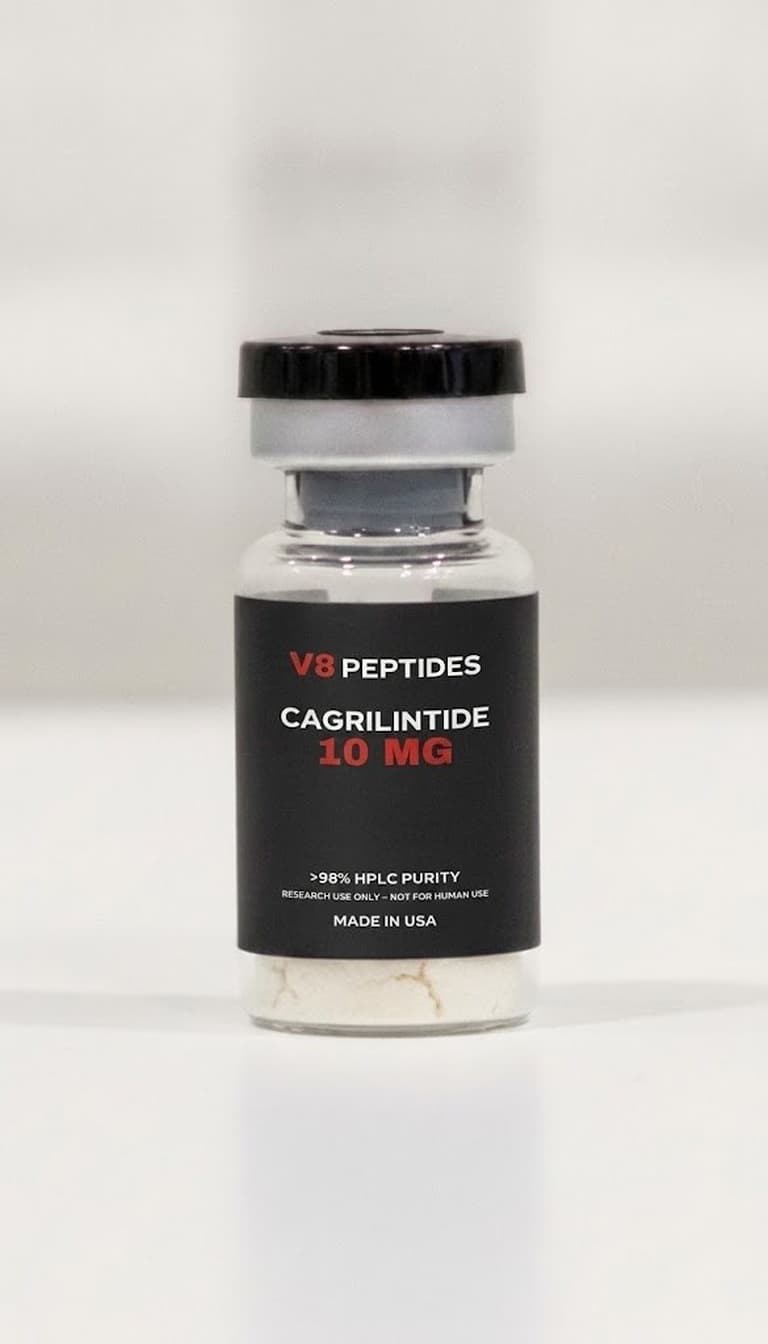
Cagrilintide
Long-acting amylin analog
$95.00
Secure payment by card link, Zelle or crypto · discreet packaging · fast USPS shipping
In stock · ships from the USA via USPS
Long-acting amylin-receptor agonist studied alongside incretin research for receptor-signaling research in assay models. ≥98% HPLC purity.
Research applications
- 01Amylin-receptor research
- 02Receptor-signaling assay models
- 03Receptor-pharmacology studies
- Sizes
- 10 mg
- Purity
- ≥98%
- Molecular formula
- C194H308N54O61
- Sequence / identity
- Reported on the certificate of analysis, where published
- Supplied form
- Lyophilized powder
- Storage
- Refrigerate at 2–8 °C; −20 °C for long-term. Protect from heat, moisture & light.
- Container
- Sealed clear glass research vial
- ✓Compound identity & sequence
- ✓Measured purity (HPLC %)
- ✓Sequence / identity confirmation
- ✓Batch / lot number
- ✓Analytical test date
- ✓Supplied form & storage
Research Use Only. All products are sold strictly for laboratory research and development purposes only. Not for human or animal consumption. Not a drug, food, or cosmetic. By purchasing, you affirm you are a qualified researcher or institution.
Batch documentation
Batch-specific analytical documentation supports receiving, verification, and internal recordkeeping.
Storage guidance
Refrigerate the supplied material, freeze for long-term storage, and protect it from heat, moisture, and light.
Research-only labeling
Every vial is clearly identified for laboratory research use only — not for human or veterinary use.
Cagrilintide research peptide, 10 mg: a lyophilized powder in a sealed glass vial, specified at ≥98% purity by HPLC. A lipidated, long-acting analog of amylin, sold for laboratory research use only and shipped within the United States. No lab report is published for this product yet; certificates from the independent lab Accumark Labs are posted on the COA page as reports come back.
What is cagrilintide?
Cagrilintide is a synthetic, long-acting analog of amylin, the 37-amino-acid peptide hormone that pancreatic beta cells release together with insulin. The analog carries a fatty-acid side chain, a lipidation strategy that promotes albumin binding and lengthens the time the molecule persists in experimental systems. It is supplied here as lyophilized powder in a sealed 10 mg vial.
In supplier catalogs and laboratory shorthand the name is often shortened to “cagri”. Both names refer to the same compound.
Researchers use cagrilintide as a tool compound for amylin- and calcitonin-receptor pharmacology. It also appears in comparative work alongside incretin-pathway peptides, where investigators examine how amylin-receptor and GLP-1-receptor signaling interact in preclinical metabolic models.
Where it is used in the lab
- Amylin- and calcitonin-receptor binding and signaling assays
- Combination studies with incretin-pathway peptides in preclinical models
- Stability and formulation analytics for lipidated peptides
For laboratory research use only; not for human consumption.
Cagrilintide specifications
| Compound | Cagrilintide |
|---|---|
| Class | Lipidated long-acting amylin analog |
| Vial size | 10 mg |
| Identity | Confirmed on the certificate of analysis, where published |
| Purity | ≥98% (HPLC) |
| Supplied form | Lyophilized powder, sealed glass vial |
| Storage | 2–8 °C; −20 °C long-term; protect from heat, moisture and light |
| Documentation | Certificates published on the COA page as reports are received |
Reconstitution & storage for research
Concentration is a simple ratio of vial content to diluent volume. Adding 2 mL of diluent to the 10 mg vial gives 5 mg/mL; 4 mL gives 2.5 mg/mL, and 1 mL gives 10 mg/mL. At 5 mg/mL, a 50 µL aliquot contains 250 µg. To check a different volume, enter the vial size into the reconstitution calculator.
A sterile diluent such as bacteriostatic water is the usual choice for multi-use research vials. Add diluent gradually against the glass, allow the cake to dissolve on its own for a minute or two, and finish with a slow swirl. Shaking is unnecessary and can introduce foam. Lipidated peptides tend to foam, so patience during dissolution pays off in a cleaner solution.
Storage conditions
- Lyophilized powder: 2–8 °C for routine storage, −20 °C for long-term holding.
- Protection: shield the vial from light, humidity and temperature swings; store it upright in its box.
- Solution: keep refrigerated, record the lot number and concentration on the vial, and avoid repeated freeze–thaw cycles by aliquoting once.
Quality & testing
Cagrilintide is supplied to a ≥98% HPLC purity specification. Certificates of Analysis for tested lots are published on the COA page; check there for this product's status, and file a copy with your receiving records.
- HPLC purity value for that specific lot
- Compound identity verification
- Lot code of the tested sample
- Date of analysis, supplied form and storage guidance
Orders ship from the US in discreet packaging, with each vial labeled for research use. We accept payment by invoice, Zelle or crypto.
Mechanism and Research Use
Native amylin is released by pancreatic beta cells with insulin, but it readily forms amyloid fibrils, which makes it hard to work with. The discovery paper reports cagrilintide as a stable, lipidated, long-acting amylin analogue developed after the earlier analogue pramlintide, which has a short half-life, and selected for clinical development (reference 1). In the lab it is used as an amylin- and calcitonin-receptor tool compound.
- Amylin- and calcitonin-receptor binding and signaling assays
- Side-by-side work with incretin-pathway peptides such as semaglutide
- Albumin-binding and stability studies on lipidated peptides
- Reference standard for HPLC method development
Shipping, Handling & Returns
Vials are made in the USA (South Carolina) and shipped from Florida by USPS to addresses in the United States only. Each vial travels sealed in its glass container. If an order arrives damaged or incorrect, contact us and we will send a replacement or refund it to the original payment method, your choice. Questions go to the support address in the site footer.
Cagrilintide Research FAQ
What is cagrilintide?
Cagrilintide is a synthetic, lipidated analog of the 37-amino-acid hormone amylin. The fatty-acid side chain promotes albumin binding and lengthens its persistence in experimental systems. It is sold here as a 10 mg research vial.
What purity is it and is there a COA?
The release specification is ≥98% purity by HPLC. No lab report is published for this product yet; certificates from the independent lab Accumark Labs are posted on the COA page as reports come back. Accumark Labs reports cover HPLC purity and identity, the measured quantity, and for most lots an endotoxin (LAL) result and a PCR sterility screen.
How do I work out a stock concentration?
2 mL of solvent in the 10 mg vial gives 5 mg/mL, 4 mL gives 2.5 mg/mL and 1 mL gives 10 mg/mL. The reconstitution calculator checks other volumes.
How should the vial be stored?
Keep the sealed vial at 2–8 °C for short-term holding or at −20 °C for long-term storage, dry and protected from light. Aliquot reconstituted stock and keep it refrigerated to avoid repeated freeze-thaw cycles.
Why does it foam when I reconstitute it?
Lipidated peptides tend to foam. Add solvent gradually against the glass, let the powder dissolve on its own for a minute or two and finish with a slow swirl instead of shaking.
Where do you ship?
Orders ship from Florida by USPS to United States addresses only. A damaged or incorrect order is replaced or refunded to the original payment method.
References
- Kruse T, Hansen JL, Dahl K, et al. Development of Cagrilintide, a Long-Acting Amylin Analogue. J Med Chem. 2021. PubMed 34288673
Related lab guides
- Cagrilintide research overview
- Cagrilintide reconstitution and storage
- How cagrilintide purity is tested
- Cagrilintide vs. pramlintide
- Cagrilintide and semaglutide combination research
- Reconstitution calculator guide
Incretin-pathway peptides frequently studied next to amylin analogs: Semaglutide, Tirzepatide, Retatrutide.
Related Lab Guides
- Cagrilintide Structure, Lipidation and Synthesis
- Cagrilintide Primer: Names, Form and Lab Uses
- Cagrilintide Rodent Studies: What Papers Report
- How to Evaluate a Cagrilintide Supplier for Lab Work
- Cagrilintide Stability: Factors and Shelf-Life Studies
- Cagrilintide Receptor Pharmacology: In-Vitro Assays
- Cagrilintide Animal Research Protocols: Design & Math
- Cagrilintide Safety Profile: Preclinical Tolerability Data
- Cagrilintide vs Tirzepatide: Assay Design and Data
- CagriSema Research: Combination Study Design
- Cagrilintide Half-Life and Preclinical Pharmacokinetics
Quick Answers
What purity is Cagrilintide?+
Cagrilintide is specified at ≥98% purity by HPLC. A certificate of analysis for this product is not published on our site yet; see the COA page for the reports that are available.
How is Cagrilintide supplied and stored?+
Cagrilintide is supplied as a lyophilized powder. Refrigerate at 2–8 °C, or freeze at −20 °C for long-term storage. Protect from heat, moisture, and light.
Do you provide a Certificate of Analysis?+
Certificates of Analysis from our independent lab are published for tested lots (see the COA page), and we add more as reports come back. Contact us for the status of a specific product or lot.
Is Cagrilintide approved for human use?+
No. This product is sold strictly for laboratory research and development purposes and is not for human or animal consumption.
Related Research
Research Library →
Cagrilintide Half-Life and Preclinical Pharmacokinetics

CagriSema Research: Combination Study Design

Cagrilintide vs Tirzepatide: Assay Design and Data
Cagrilintide Animal Research Protocols: Design & Math

Cagrilintide Safety Profile: Preclinical Tolerability Data