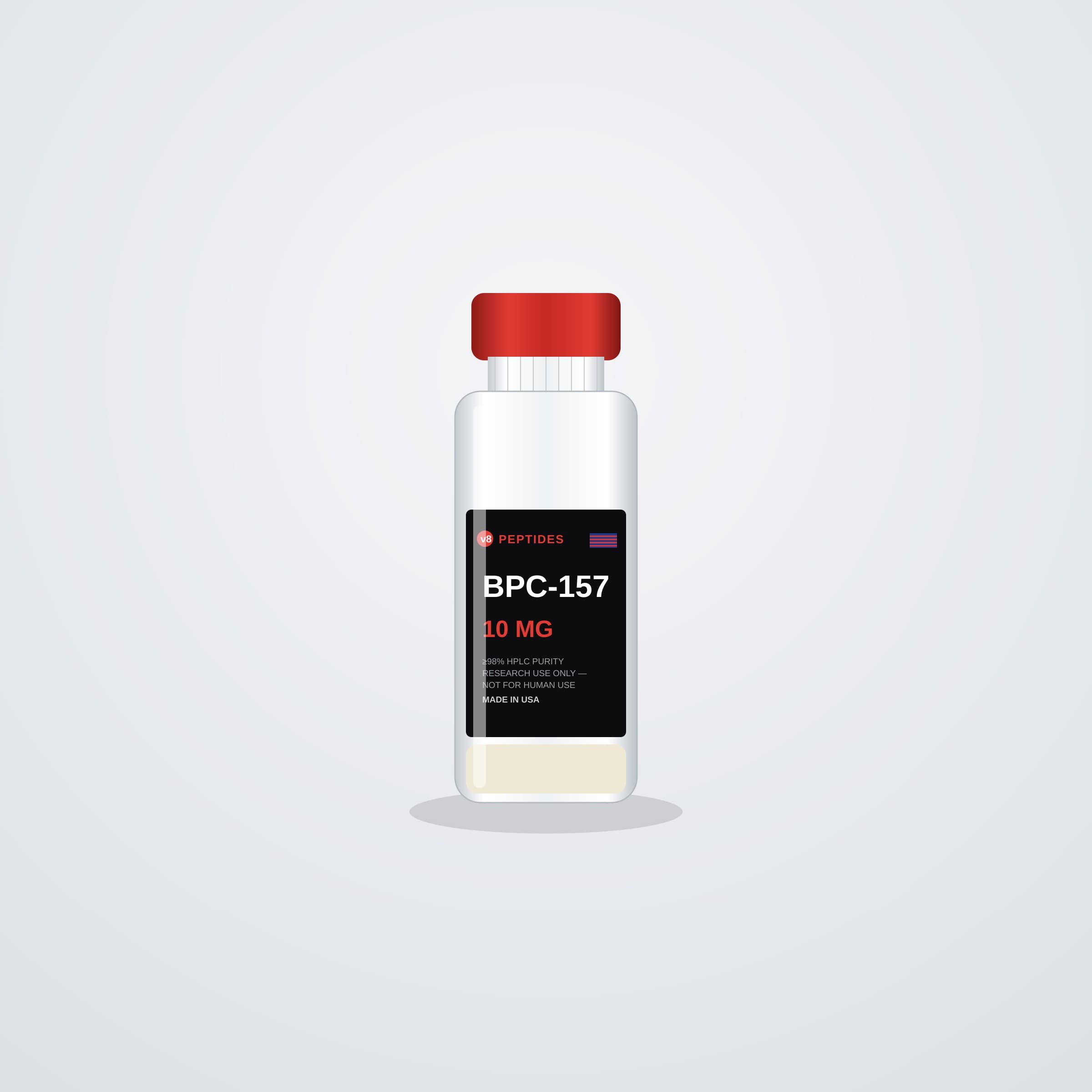
BPC-157
Body Protection Compound
$74.00
Secure payment by card link, Zelle or crypto · discreet packaging · fast USPS shipping
Synthetic pentadecapeptide researched for tissue repair, cellular regeneration, and cytoprotection mechanisms. Verified ≥98% HPLC purity.
Research applications
- 01Tissue-response pathway models
- 02Extracellular-matrix signaling
- 03Tendon & ligament research
- 04Gastrointestinal research models
- Sizes
- 10 mg
- Purity
- ≥98%
- Sequence / identity
- Gly-Glu-Pro-Pro-Pro-Gly-Lys-Pro-Ala-Asp-Asp-Ala-Gly-Leu-Val
- Supplied form
- Lyophilized powder
- Storage
- Refrigerate at 2–8 °C; −20 °C for long-term. Protect from heat, moisture & light.
- Container
- Sealed clear glass research vial
- ✓Compound identity & sequence
- ✓Measured purity (HPLC %)
- ✓Sequence / identity confirmation
- ✓Batch / lot number
- ✓Analytical test date
- ✓Supplied form & storage
Research Use Only. All products are sold strictly for laboratory research and development purposes only. Not for human or animal consumption. Not a drug, food, or cosmetic. By purchasing, you affirm you are a qualified researcher or institution.
Batch documentation
Batch-specific analytical documentation supports receiving, verification, and internal recordkeeping.
Storage guidance
Refrigerate the supplied material, freeze for long-term storage, and protect it from heat, moisture, and light.
Research-only labeling
Every vial is clearly identified for laboratory research use only — not for human or veterinary use.
What Is BPC-157?
BPC-157 is a synthetic pentadecapeptide, meaning a chain of fifteen amino acids, with the sequence Gly-Glu-Pro-Pro-Pro-Gly-Lys-Pro-Ala-Asp-Asp-Ala-Gly-Leu-Val. The sequence corresponds to a partial segment of a larger protein first isolated from gastric juice, which is where the name "Body Protection Compound" comes from. The peptide itself is made by solid-phase synthesis and does not occur as a free molecule in nature.
Its small size, proline-rich core and good aqueous solubility make BPC-157 easy to handle at the bench, and it has built up a large preclinical literature. Laboratories use it in cell-culture and animal models that examine tissue-response pathways, extracellular-matrix signaling, angiogenesis-related gene expression, and tendon, ligament and gastrointestinal tissue biology. It is also a frequent choice as a stable, short-chain standard for HPLC and mass spectrometry work. V8 Peptides supplies BPC-157 as a 10 mg lyophilized powder.
BPC-157 Specifications
| Compound | BPC-157 (Body Protection Compound-157) |
|---|---|
| Vial size | 10 mg |
| Purity | ≥98% by HPLC |
| Sequence | Gly-Glu-Pro-Pro-Pro-Gly-Lys-Pro-Ala-Asp-Asp-Ala-Gly-Leu-Val |
| Length | 15 amino acids |
| Form | Lyophilized powder, sealed clear glass vial |
| Storage | 2–8 °C short term; −20 °C long term |
Reconstitution & Storage for Research
BPC-157 dissolves readily in water-based diluents. What changes from lab to lab is the stock strength, which depends entirely on how much liquid goes into the vial.
Concentration math
- Adding 2 mL of diluent to a 10 mg vial gives 5 mg/mL.
- Adding 1 mL of diluent to a 10 mg vial gives 10 mg/mL.
- Adding 4 mL of diluent to a 10 mg vial gives 2.5 mg/mL.
- Because 1 mg equals 1,000 µg, a 5 mg/mL stock is the same as 5,000 µg/mL, or 500 µg per 0.1 mL.
If you would rather not convert units by hand, enter the vial size and volume into the peptide calculator. During reconstitution, tilt the vial, release the diluent against the glass and swirl lightly until the powder disappears. There is no need to shake a peptide this soluble.
Storage conditions
Refrigerate sealed vials at 2–8 °C and use a −20 °C freezer for extended storage. Protect the product from heat, moisture and light. Solutions should be kept cold, labeled with the preparation date and concentration, and aliquoted if they will be used across several sessions. Our BPC-157 reconstitution and storage notes go through the handling variables one by one.
Quality & Testing
Short peptides are straightforward to synthesize, but deletion sequences and residual reagents can still end up in a poorly purified lot. That is why each BPC-157 batch we release is checked by HPLC and must reach ≥98% purity.
- Batch-specific HPLC purity figure
- Sequence and identity confirmation
- Lot number and analytical test date
- Form and storage statement for receiving records
The certificate of analysis for every lot is available on the COA page. For a walkthrough of the chromatogram and what counts as an acceptable impurity profile, read BPC-157 purity testing.
Related Lab Guides
- BPC-157 reconstitution and storage
- BPC-157 chemical structure and synthesis
- BPC-157 mechanism of action in research models
- BPC-157 vs. TB-500
- Where to buy BPC-157 for research
- How to reconstitute a lyophilized peptide
For laboratory research use only; not for human consumption.
Frequently Asked Questions
What purity is BPC-157?+
BPC-157 is verified to ≥98% purity by HPLC, with identity confirmed by batch-specific analytical documentation (COA) published on our site.
How is BPC-157 supplied and stored?+
BPC-157 is supplied as a lyophilized powder. Refrigerate at 2–8 °C, or freeze at −20 °C for long-term storage. Protect from heat, moisture, and light.
Do you provide a Certificate of Analysis?+
Yes — every batch ships with batch-specific analytical documentation (COA) to support qualified receiving and internal recordkeeping.
Is BPC-157 approved for human use?+
No. This product is sold strictly for laboratory research and development purposes and is not for human or animal consumption.