MOTS-c
Mitochondrial-derived peptide
$55.00
Secure payment by card link, Zelle or crypto · discreet packaging · fast USPS shipping
Mitochondrial-derived peptide encoded in the 12S rRNA studied for metabolic-homeostasis and AMPK-signaling research. ≥98% HPLC purity.
Research applications
- 01AMPK-pathway research
- 02Mitochondrial metabolism models
- 03Metabolic-homeostasis studies
- Sizes
- 10 mg
- Purity
- ≥98%
- Molecular formula
- C101H152N28O22S2
- Sequence / identity
- Met-Arg-Trp-Gln-Glu-Met-Gly-Tyr-Ile-Phe-Tyr-Pro-Arg-Lys-Leu-Arg
- Supplied form
- Lyophilized powder
- Storage
- Refrigerate at 2–8 °C; −20 °C for long-term. Protect from heat, moisture & light.
- Container
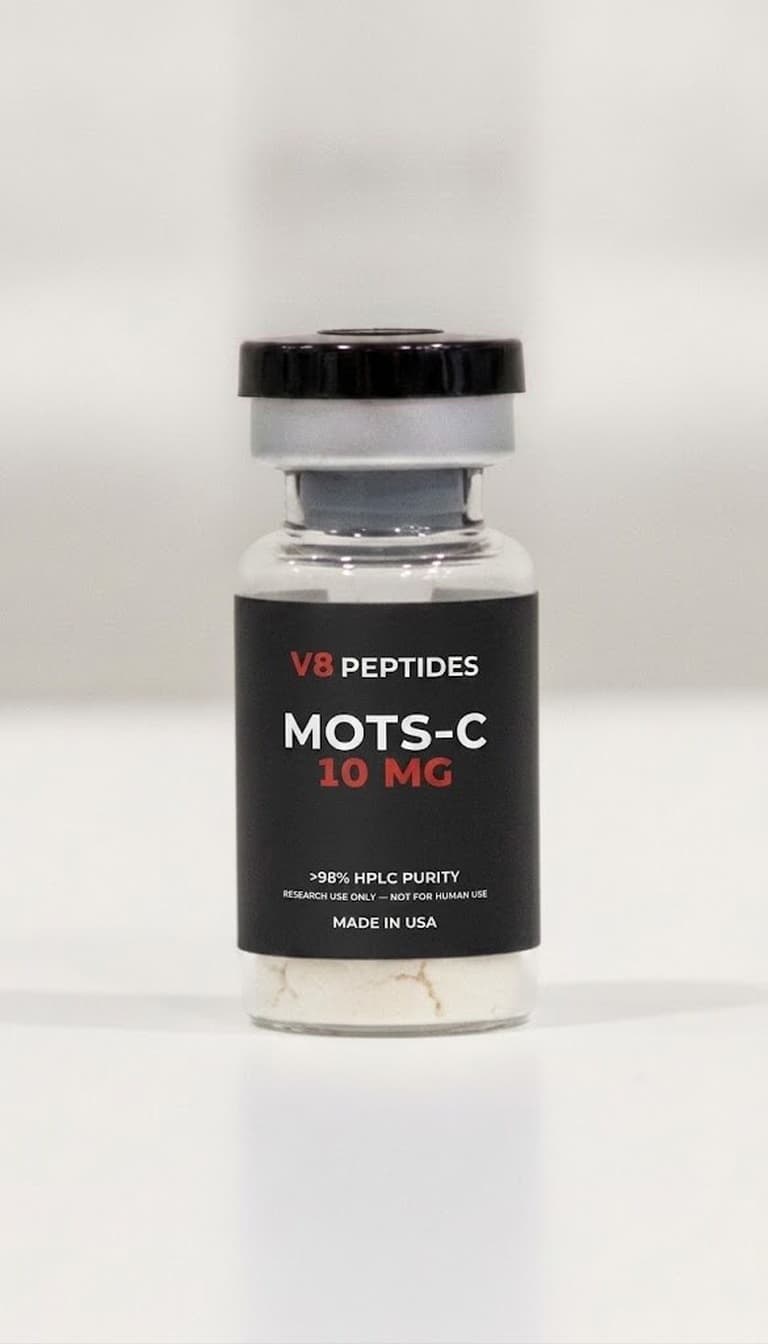
- Sealed clear glass research vial
- ✓Compound identity & sequence
- ✓Measured purity (HPLC %)
- ✓Sequence / identity confirmation
- ✓Batch / lot number
- ✓Analytical test date
- ✓Supplied form & storage
Research Use Only. All products are sold strictly for laboratory research and development purposes only. Not for human or animal consumption. Not a drug, food, or cosmetic. By purchasing, you affirm you are a qualified researcher or institution.
Batch documentation
Batch-specific analytical documentation supports receiving, verification, and internal recordkeeping.
Storage guidance
Refrigerate the supplied material, freeze for long-term storage, and protect it from heat, moisture, and light.
Research-only labeling
Every vial is clearly identified for laboratory research use only — not for human or veterinary use.
What is MOTS-c?
MOTS-c is a 16-amino-acid peptide encoded by a short open reading frame inside the mitochondrial 12S rRNA gene. First reported in 2015, it belongs to the small group of mitochondrial-derived peptides, alongside humanin, whose coding sequences sit in the mitochondrial genome instead of the nuclear one.
In the laboratory, synthetic MOTS-c is used to study how a mitochondrially encoded signal interacts with cellular energy sensing. Much of the published work examines AMPK-pathway activity and metabolic homeostasis in cultured cells and rodent models. V8 Peptides supplies the peptide as lyophilized powder in a 10 mg vial.
Where it is used in the lab
- AMPK-pathway signaling assays in cell culture
- Mitochondrial metabolism and nuclear cross-talk studies
- Metabolic-homeostasis experiments in preclinical models
For laboratory research use only; not for human consumption.
MOTS-c specifications
| Compound | MOTS-c |
|---|---|
| Class | 16-amino-acid mitochondrial-derived peptide |
| Vial size | 10 mg |
| Molecular formula | C101H152N28O22S2 |
| Purity | ≥98% (HPLC) |
| Supplied form | Lyophilized powder, sealed glass vial |
| Storage | 2–8 °C; −20 °C long-term; protect from heat, moisture and light |
| Documentation | Batch-specific COA |
Reconstitution & storage for research
Adding 2 mL of diluent to the 10 mg vial gives 5 mg/mL; adding 1 mL gives 10 mg/mL for a more concentrated stock. At 5 mg/mL, a 100 µL aliquot contains 500 µg and a 200 µL aliquot contains 1 mg. Our reconstitution calculator runs the same arithmetic for any vial size and diluent volume.
A sterile diluent such as bacteriostatic water is the usual choice for multi-use research vials. Direct the diluent slowly down the inside wall of the vial instead of onto the powder, then swirl gently until the solution is clear. Do not shake; vigorous agitation can foam or shear the material. The sequence includes two methionine residues, which are prone to oxidation, so keep solutions cold and limit air exposure.
Storage conditions
- Unopened vial: refrigerate at 2–8 °C; move to −20 °C if the vial will sit for an extended period.
- Environment: keep the powder away from heat, moisture and direct light, and let a cold vial reach room temperature before opening so condensation does not form inside.
- After reconstitution: return the solution to 2–8 °C, label it with concentration and preparation date, and split it into aliquots if it will be sampled more than a few times.
Quality & testing
Every lot of MOTS-c is analyzed by high-performance liquid chromatography (HPLC) before release, against a specification of ≥98% purity. The result is recorded on a batch-specific Certificate of Analysis, published on our COA page, so you can match the lot number on the vial to the document before the material enters your workflow.
- Measured HPLC purity, reported as a percentage
- Identity confirmation for the compound
- Batch / lot number and analytical test date
- Supplied form and storage conditions
Vials are sealed, labeled for research use and shipped within the United States in discreet packaging. Payment is by invoice or Zelle.
Related lab guides
- MOTS-c research overview
- MOTS-c reconstitution and storage
- How MOTS-c purity is tested
- MOTS-c chemical structure and synthesis
- MOTS-c vs. other mitochondrial-derived peptides
- Reconstitution calculator guide
Other compounds used in cellular-metabolism research: NAD+ 1000 mg, AOD-9604.
Frequently Asked Questions
What purity is MOTS-c?+
MOTS-c is verified to ≥98% purity by HPLC, with identity confirmed by batch-specific analytical documentation (COA) published on our site.
How is MOTS-c supplied and stored?+
MOTS-c is supplied as a lyophilized powder. Refrigerate at 2–8 °C, or freeze at −20 °C for long-term storage. Protect from heat, moisture, and light.
Do you provide a Certificate of Analysis?+
Yes — every batch ships with batch-specific analytical documentation (COA) to support qualified receiving and internal recordkeeping.
Is MOTS-c approved for human use?+
No. This product is sold strictly for laboratory research and development purposes and is not for human or animal consumption.