KLOW Stack
GHK-Cu + KPV + BPC-157 + TB-500 blend
$152.00
Secure payment by card link, Zelle or crypto · discreet packaging · fast USPS shipping
In stock · ships from the USA via USPS
Multi-peptide research blend (GHK-Cu, KPV, BPC-157, TB-500) for combined extracellular-matrix and cell-signaling research. ≥98% HPLC purity.
Research applications
- 01Combined ECM & cell signaling
- 02Copper-peptide + melanocortin models
- 03Multi-pathway tissue research
- Sizes
- 80 mg blend
- Purity
- ≥98%
- Molecular formula
- Blend
- Sequence / identity
- Reported on the certificate of analysis, where published
- Supplied form
- Lyophilized powder
- Storage
- Refrigerate at 2–8 °C; −20 °C for long-term. Protect from heat, moisture & light.
- Container
- Sealed clear glass research vial
- ✓Compound identity & sequence
- ✓Measured purity (HPLC %)
- ✓Sequence / identity confirmation
- ✓Batch / lot number
- ✓Analytical test date
- ✓Supplied form & storage
Research Use Only. All products are sold strictly for laboratory research and development purposes only. Not for human or animal consumption. Not a drug, food, or cosmetic. By purchasing, you affirm you are a qualified researcher or institution.
Batch documentation
Batch-specific analytical documentation supports receiving, verification, and internal recordkeeping.
Storage guidance
Refrigerate the supplied material, freeze for long-term storage, and protect it from heat, moisture, and light.
Research-only labeling
Every vial is clearly identified for laboratory research use only — not for human or veterinary use.
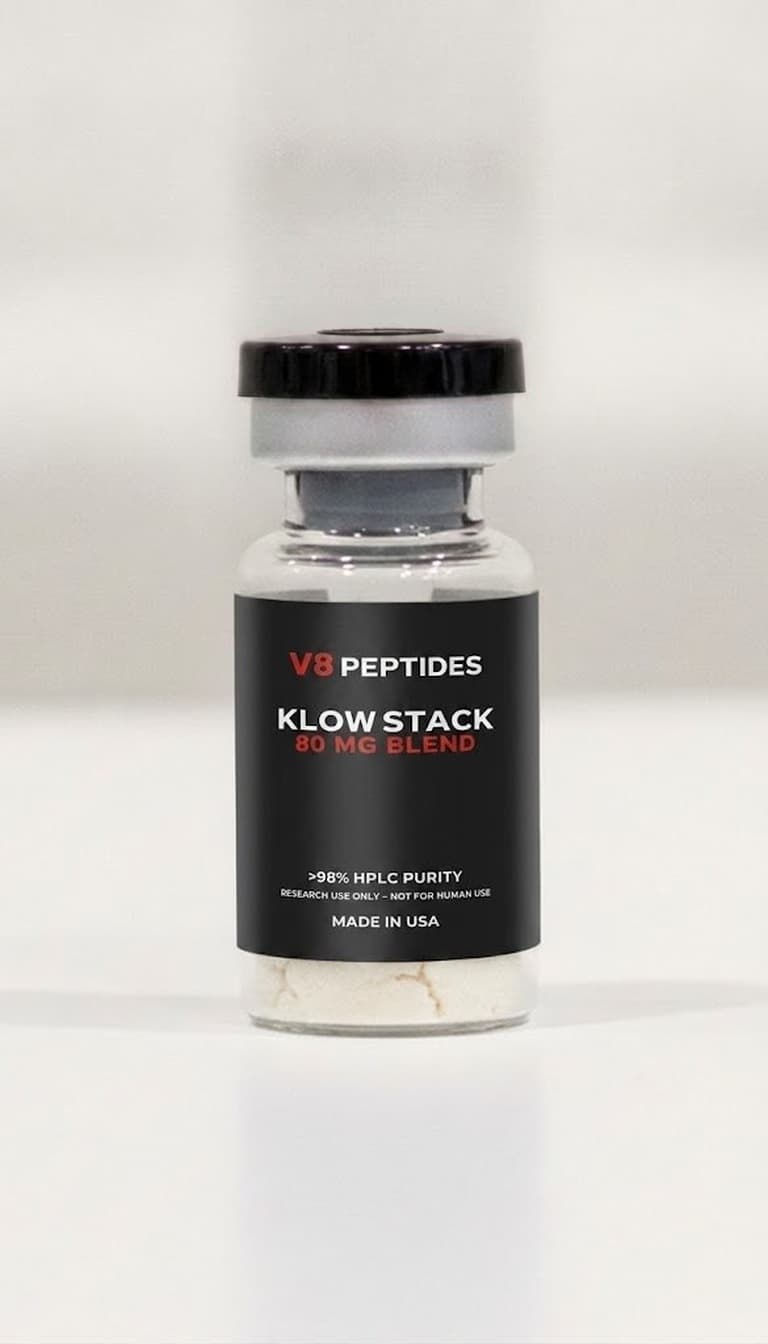
KLOW Stack (GHK-Cu + KPV + BPC-157 + TB-500), 80 mg: a co-lyophilized four-peptide research blend in one sealed glass vial, specified at ≥98% purity by HPLC. with a lot-specific certificate of analysis from the independent lab Accumark Labs published on our COA page. Sold for laboratory research use only; ships from Florida by USPS to US addresses.
What Is the KLOW Stack?
The KLOW Stack is a four-peptide research blend supplied as one co-lyophilized vial with 80 mg of total peptide. It contains GHK-Cu, KPV, BPC-157 and TB-500, and it extends the familiar three-peptide GHK-Cu / BPC-157 / TB-500 combination by adding the melanocortin-derived tripeptide KPV.
The four components
- GHK-Cu is a copper-binding tripeptide (Gly-His-Lys) used in fibroblast, collagen and extracellular-matrix studies.
- KPV (Lys-Pro-Val) is the C-terminal tripeptide of α-melanocyte-stimulating hormone and is used to probe inflammation-signaling pathways such as NF-κB in cell models.
- BPC-157 is a 15-amino-acid synthetic peptide examined in tissue-response and matrix-signaling research.
- TB-500 is a thymosin beta-4 derived peptide used in actin-regulation and cell-migration assays.
Researchers choose a blend like this for multi-pathway tissue models in which copper-peptide, melanocortin and cell-signaling motifs are examined in parallel. One vial with a fixed composition keeps the ratio constant from experiment to experiment.
KLOW Stack Specifications
| Contents | GHK-Cu + KPV + BPC-157 + TB-500 |
|---|---|
| Total peptide | 80 mg blend per vial |
| Purity | ≥98% by HPLC |
| Identity | Component identity reported on the batch COA |
| Form | Co-lyophilized powder, sealed clear glass vial |
| Storage | 2–8 °C short term; −20 °C long term |
Reconstitution & Storage for Research
Start with the total: 80 mg divided by the diluent volume gives the overall peptide concentration. The concentration of any single component is then its stated mass divided by the same volume.
Concentration math
- Adding 2 mL of diluent to the 80 mg vial gives 40 mg/mL total peptide.
- Adding 2.5 mL of diluent gives 32 mg/mL total peptide.
- Adding 3.2 mL of diluent gives 25 mg/mL total peptide.
- Per-component example: a component present at 10 mg, dissolved in 2 mL, is at 5 mg/mL.
Use the calculator to check each figure and note them on the vial. As with any GHK-Cu blend, expect a blue cake and a blue solution; the color comes from the copper complex. Add diluent slowly along the glass and swirl until clear. Do not shake or vortex a four-component mixture.
Storage conditions
Sealed vials keep best at 2–8 °C, with −20 °C recommended for long-term storage. Avoid heat, humidity and light. After reconstitution, refrigerate the solution, protect it from light and aliquot it to reduce handling. Component-level considerations are covered in KLOW Stack reconstitution and storage.
Quality & Testing
The more peptides in a vial, the more important the paperwork. Each KLOW Stack lot is tested by HPLC and released only at ≥98% purity, with a certificate of analysis tied to the batch number.
- Lot-specific HPLC purity
- Identity confirmation for the blend components
- Batch number and analytical test date
- Supplied form and storage conditions
Find the report for your lot on the COA page. The article on KLOW Stack purity testing explains how chromatography separates and verifies several peptides in one sample.
Mechanism and Research Use
KLOW adds KPV (Lys-Pro-Val, the C-terminal tripeptide of α-MSH) to the GHK-Cu / BPC-157 / TB-500 combination. In cell work, nanomolar KPV inhibited NF-κB and MAP-kinase signaling and reduced pro-inflammatory cytokine secretion, and it entered intestinal epithelial and immune cells through the PepT1 transporter (reference 1). In two mouse colitis models it reduced inflammatory infiltrates, and the effect appeared at least partly independent of the melanocortin-1 receptor (reference 2).
The other three components are described in the literature as follows: GHK is reviewed as a modulator of collagen, glycosaminoglycan and metalloproteinase activity in skin and wound models (reference 3); BPC-157 raised tendon-fibroblast migration and survival under oxidative stress in vitro (reference 4); TB-500 is the acetylated LKKTETQ (17–23) actin-binding fragment of thymosin β4 (reference 5).
- NF-κB and cytokine-signaling readouts in epithelial and immune cell lines
- Fibroblast migration, extracellular-matrix and angiogenesis models
- Four-component HPLC method development; the copper complex makes the solution blue
Shipping, Handling & Returns
Vials are produced in South Carolina and shipped from Florida by USPS to addresses in the United States only. Each vial travels sealed in its original glass container. If an order arrives damaged or incorrect, contact us within 48 hours of delivery and we will arrange a replacement or a refund to the original payment method. Questions go to the support address in the site footer.
KLOW Research FAQ
What is in the KLOW vial?
GHK-Cu, KPV, BPC-157 and TB-500 co-lyophilized in one vial, 80 mg of peptide in total. Sold for laboratory research use only.
What is TB-500 in this product?
The acetylated thymosin β4 fragment 17–23 (Ac-LKKTETQ), not full-length thymosin β4. The lab report lists it as “TB500 (17-23 Fragment)”.
Is there a lab report for KLOW?
The lot report is on our COA page: lot ARC-KL80-004, published 18 Oct 2026, from Accumark Labs. It lists HPLC purity and identity, measured quantity, an endotoxin (LAL) result and a PCR sterility screen; total purity on that report is 99.79%. Each of the four components has its own identity, quantity and purity line. The report carries a lab sample code that can be checked on the Accumark Labs verification page. Vials carry no printed lot number, so the report is matched by product and lot code.
How do I make a stock solution?
Total concentration is 80 mg divided by the solvent volume: 2 mL gives 40 mg/mL of total peptide. Any single component is its own mass divided by the same volume. The reconstitution calculator does the arithmetic.
How should the vial be stored?
Keep the sealed vial at 2–8 °C for short-term holding or at −20 °C for long-term storage, dry and protected from light. Divide reconstituted stock into aliquots and keep it refrigerated to avoid repeated freeze-thaw cycles.
Do you ship outside the United States?
No. Orders ship from Florida by USPS to United States addresses only. A damaged or incorrect order is replaced or refunded to the original payment method.
References
- Dalmasso G, Charrier-Hisamuddin L, Nguyen HT, et al. PepT1-mediated tripeptide KPV uptake reduces intestinal inflammation. Gastroenterology. 2008;134(1):166-178. PubMed 18061177
- Kannengiesser K, Maaser C, Heidemann J, et al. Melanocortin-derived tripeptide KPV has anti-inflammatory potential in murine models of inflammatory bowel disease. Inflamm Bowel Dis. 2008;14(3):324-331. PubMed 18092346
- Pickart L, Vasquez-Soltero JM, Margolina A. GHK peptide as a natural modulator of multiple cellular pathways in skin regeneration. Biomed Res Int. 2015;2015:648108. PubMed 26236730
- Chang CH, Tsai WC, Lin MS, et al. The promoting effect of pentadecapeptide BPC 157 on tendon healing involves tendon outgrowth, cell survival, and cell migration. J Appl Physiol. 2011;110(3):774-780. PubMed 21030672
- Sosne G, Qiu P, Goldstein AL, Wheater M. Biological activities of thymosin beta4 defined by active sites in short peptide sequences. FASEB J. 2010;24(7):2144-2151. PubMed 20179146
Related Lab Guides
- KLOW peptide explained: GHK-Cu, KPV, BPC-157 and TB-500
- KLOW Stack research overview
- KLOW Stack reconstitution and storage
- KPV research overview
- Glow peptide blend overview
- Peptide blends and research stacks
- KLOW Stack Reconstitution: Four-Peptide Blend Math
- KLOW Stack: Component Evidence and Interaction Design
- KLOW Stack Skin and Tissue Models: Evidence by Peptide
- KLOW Stack Gut and Immune Models: KPV and BPC-157
- KLOW Stack Storage: Temperature, Light and Shelf Life
- KLOW vs GLOW Stack: What KPV Adds to the Blend
- KPV in the KLOW Stack: Gut and Inflammation Research
- KLOW Stack: How to Verify a Four-Peptide Blend
For laboratory research use only; not for human consumption.
Quick Answers
What purity is KLOW Stack?+
KLOW Stack is verified to ≥98% purity by HPLC, with identity confirmed by batch-specific analytical documentation (COA) published on our site.
How is KLOW Stack supplied and stored?+
KLOW Stack is supplied as a lyophilized powder. Refrigerate at 2–8 °C, or freeze at −20 °C for long-term storage. Protect from heat, moisture, and light.
Do you provide a Certificate of Analysis?+
Certificates of Analysis from our independent lab are published for tested lots (see the COA page), and we add more as reports come back. Contact us for the status of a specific product or lot.
Is KLOW Stack approved for human use?+
No. This product is sold strictly for laboratory research and development purposes and is not for human or animal consumption.
Related Research
Research Library →
KLOW Stack: How to Verify a Four-Peptide Blend

KPV in the KLOW Stack: Gut and Inflammation Research

KLOW vs GLOW Stack: What KPV Adds to the Blend

KLOW Stack: Component Evidence and Interaction Design

KLOW Stack Gut and Immune Models: KPV and BPC-157