IGF-1 LR3
Long R3 insulin-like growth factor 1
$75.00
Secure payment by card link, Zelle or crypto · discreet packaging · fast USPS shipping
Long-arginine-3 analog of IGF-1 studied for extended half-life and IGF-receptor signaling in cell-culture research. ≥98% HPLC purity.
Research applications
- 01IGF-1 receptor signaling
- 02Cell-proliferation / culture research
- 03Anabolic-pathway models
- Sizes
- 1 mg
- Purity
- ≥98%
- Molecular formula
- C400H625N111O115S9
- Sequence / identity
- Provided on batch COA
- Supplied form
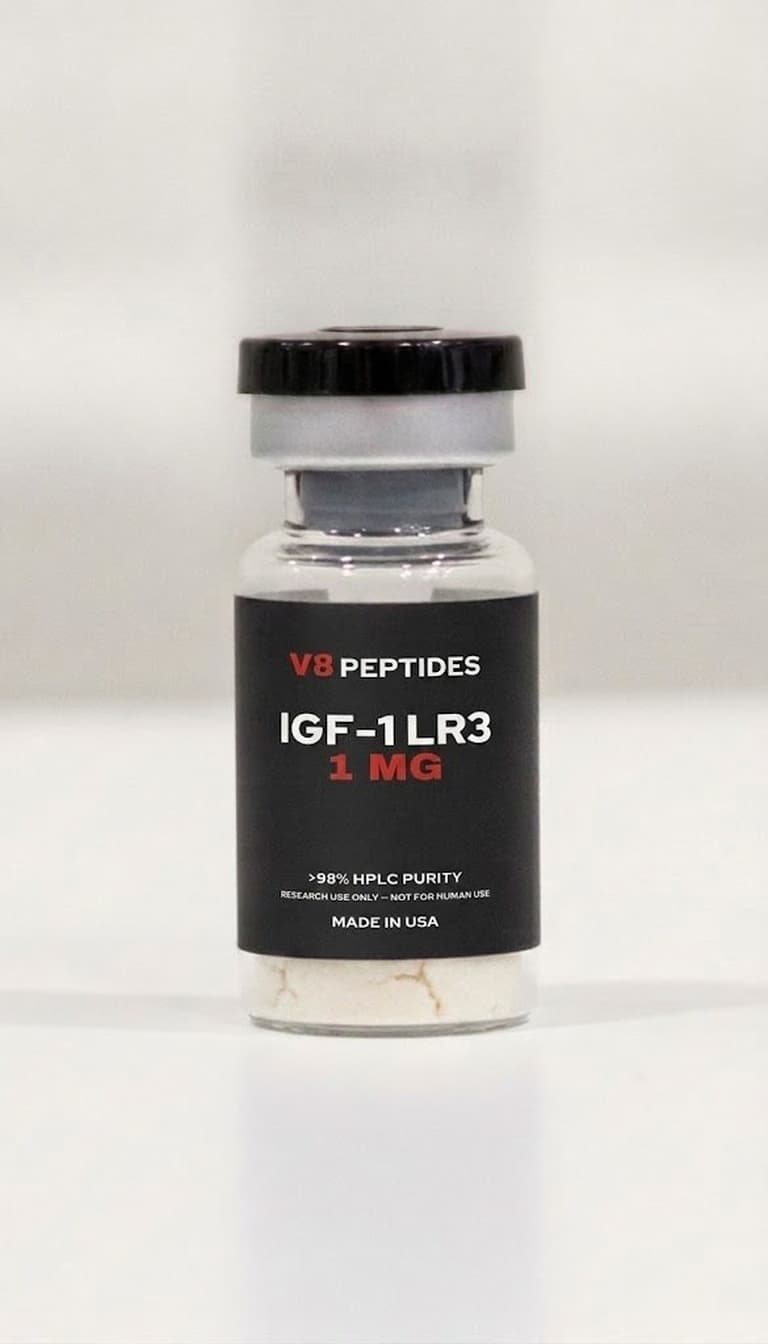
- Lyophilized powder
- Storage
- Refrigerate at 2–8 °C; −20 °C for long-term. Protect from heat, moisture & light.
- Container
- Sealed clear glass research vial
- ✓Compound identity & sequence
- ✓Measured purity (HPLC %)
- ✓Sequence / identity confirmation
- ✓Batch / lot number
- ✓Analytical test date
- ✓Supplied form & storage
Research Use Only. All products are sold strictly for laboratory research and development purposes only. Not for human or animal consumption. Not a drug, food, or cosmetic. By purchasing, you affirm you are a qualified researcher or institution.
Batch documentation
Batch-specific analytical documentation supports receiving, verification, and internal recordkeeping.
Storage guidance
Refrigerate the supplied material, freeze for long-term storage, and protect it from heat, moisture, and light.
Research-only labeling
Every vial is clearly identified for laboratory research use only — not for human or veterinary use.
What is IGF-1 LR3?
IGF-1 LR3 (Long R3 IGF-1) is an 83-amino-acid analog of human insulin-like growth factor 1. Two changes separate it from the native 70-residue protein: arginine replaces glutamic acid at position 3, and a 13-amino-acid extension is added at the N-terminus. Together these modifications sharply reduce binding to IGF-binding proteins.
That reduced binding is the reason the analog is so widely used in mammalian cell culture, where it is added to serum-free media and used to probe IGF-1 receptor signaling without interference from binding proteins in the system. At roughly 9.1 kDa it is far larger than most catalog peptides, so it is supplied in a 1 mg vial and handled more like a small protein.
Where it is used in the lab
- IGF-1 receptor signaling assays (PI3K/Akt and MAPK readouts)
- Serum-free media supplementation in mammalian cell culture
- Binding-protein interaction studies against native IGF-1
For laboratory research use only; not for human consumption.
IGF-1 LR3 specifications
| Compound | IGF-1 LR3 (Long R3 IGF-1) |
|---|---|
| Class | 83-amino-acid IGF-1 analog |
| Vial size | 1 mg |
| Molecular formula | C400H625N111O115S9 |
| Purity | ≥98% (HPLC) |
| Supplied form | Lyophilized powder, sealed glass vial |
| Storage | 2–8 °C; −20 °C long-term; protect from heat, moisture and light |
| Documentation | Batch-specific COA |
Reconstitution & storage for research
Adding 1 mL of diluent to the 1 mg vial gives 1 mg/mL (1,000 µg/mL); adding 2 mL gives 0.5 mg/mL (500 µg/mL). Cell-culture work usually runs at far lower working concentrations, so plan a serial dilution: 10 µL of a 1 mg/mL stock carries 10 µg. Our reconstitution calculator runs the same arithmetic for any vial size and diluent volume.
A sterile diluent such as bacteriostatic water is the usual choice for multi-use research vials. Direct the diluent slowly down the inside wall of the vial instead of onto the powder, then swirl gently until the solution is clear. Do not shake; vigorous agitation can foam or shear the material. Use the solvent your protocol specifies for the stock, and prefer low-protein-binding tubes for dilute aliquots, since proteins of this size adsorb to standard plastic.
Storage conditions
- Unopened vial: refrigerate at 2–8 °C; move to −20 °C if the vial will sit for an extended period.
- Environment: keep the powder away from heat, moisture and direct light, and let a cold vial reach room temperature before opening so condensation does not form inside.
- After reconstitution: return the solution to 2–8 °C, label it with concentration and preparation date, and split it into aliquots if it will be sampled more than a few times.
Quality & testing
Every lot of IGF-1 LR3 is analyzed by high-performance liquid chromatography (HPLC) before release, against a specification of ≥98% purity. The result is recorded on a batch-specific Certificate of Analysis, published on our COA page, so you can match the lot number on the vial to the document before the material enters your workflow.
- Measured HPLC purity, reported as a percentage
- Identity confirmation for the compound
- Batch / lot number and analytical test date
- Supplied form and storage conditions
Vials are sealed, labeled for research use and shipped within the United States in discreet packaging. Payment is by invoice or Zelle.
Related lab guides
- IGF-1 LR3 research overview
- IGF-1 LR3 reconstitution and storage
- How IGF-1 LR3 purity is tested
- IGF-1 LR3 chemical structure and synthesis
- Reconstitution calculator guide
- HPLC vs. mass spectrometry
GHRH analogs used upstream of IGF-1 in somatotropic-axis research: Sermorelin, Tesamorelin, CJC-1295 (No DAC).
Frequently Asked Questions
What purity is IGF-1 LR3?+
IGF-1 LR3 is verified to ≥98% purity by HPLC, with identity confirmed by batch-specific analytical documentation (COA) published on our site.
How is IGF-1 LR3 supplied and stored?+
IGF-1 LR3 is supplied as a lyophilized powder. Refrigerate at 2–8 °C, or freeze at −20 °C for long-term storage. Protect from heat, moisture, and light.
Do you provide a Certificate of Analysis?+
Yes — every batch ships with batch-specific analytical documentation (COA) to support qualified receiving and internal recordkeeping.
Is IGF-1 LR3 approved for human use?+
No. This product is sold strictly for laboratory research and development purposes and is not for human or animal consumption.