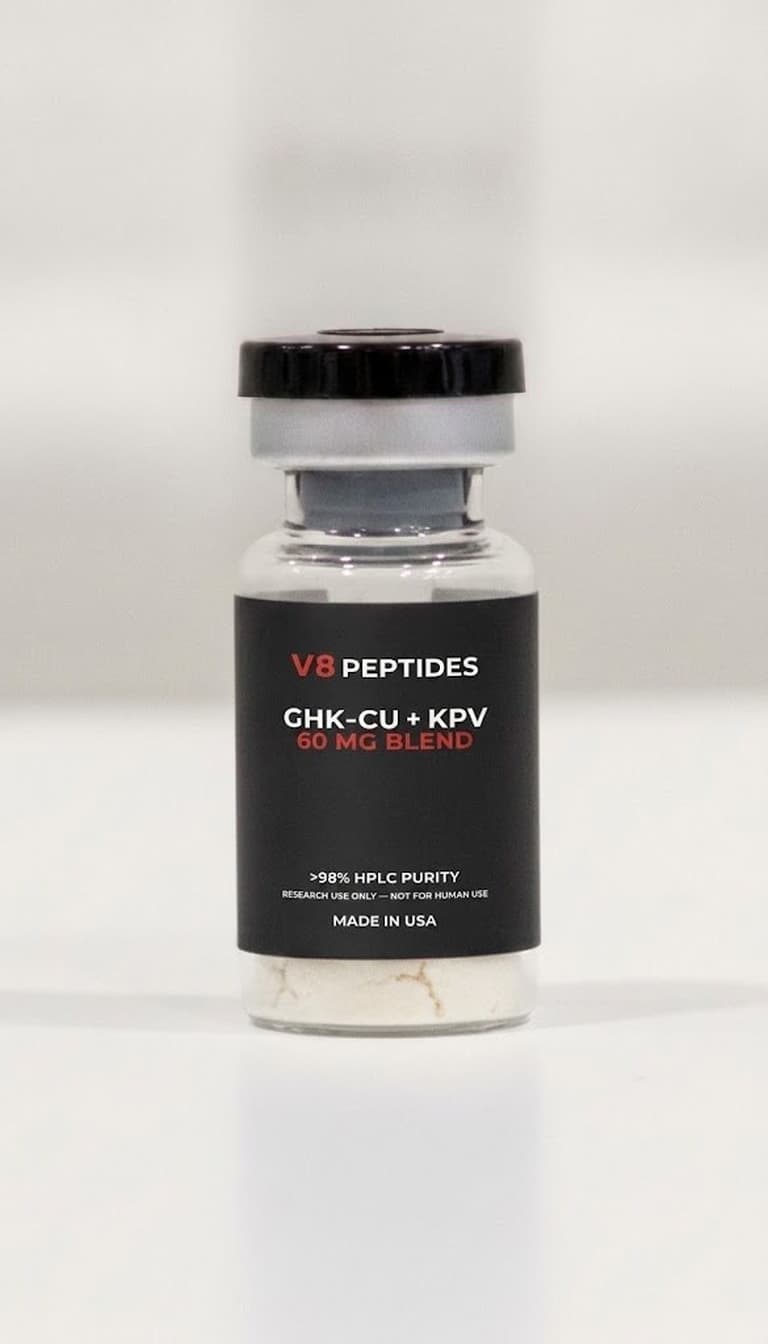
GHK-Cu + KPV
Skin & anti-inflammatory blend
$88.00
Secure payment by card link, Zelle or crypto · discreet packaging · fast USPS shipping
In stock · ships from the USA via USPS
Research blend combining GHK-Cu copper tripeptide with KPV (α-MSH C-terminal tripeptide) for skin and inflammation-signaling research. ≥98% HPLC purity.
Research applications
- 01Copper-peptide signaling
- 02Melanocortin (KPV) anti-inflammatory models
- 03Dermal ECM research
- Sizes
- 60 mg blend
- Purity
- ≥98%
- Molecular formula
- Blend
- Sequence / identity
- Reported on the certificate of analysis, where published
- Supplied form
- Lyophilized powder
- Storage
- Refrigerate at 2–8 °C; −20 °C for long-term. Protect from heat, moisture & light.
- Container
- Sealed clear glass research vial
- ✓Compound identity & sequence
- ✓Measured purity (HPLC %)
- ✓Sequence / identity confirmation
- ✓Batch / lot number
- ✓Analytical test date
- ✓Supplied form & storage
Research Use Only. All products are sold strictly for laboratory research and development purposes only. Not for human or animal consumption. Not a drug, food, or cosmetic. By purchasing, you affirm you are a qualified researcher or institution.
Batch documentation
Batch-specific analytical documentation supports receiving, verification, and internal recordkeeping.
Storage guidance
Refrigerate the supplied material, freeze for long-term storage, and protect it from heat, moisture, and light.
Research-only labeling
Every vial is clearly identified for laboratory research use only — not for human or veterinary use.
GHK-Cu + KPV research blend, 60 mg total: two short peptides, the copper complex GHK-Cu and the tripeptide KPV, together in one lyophilized sealed glass vial, specified at ≥98% purity by HPLC. Sold for laboratory research use only and shipped within the United States. No lab report is published for this product yet; certificates from the independent lab Accumark Labs are posted on the COA page as reports come back.
What is the GHK-Cu + KPV blend?
This product combines two short peptides in a single lyophilized vial. GHK-Cu is the copper(II) complex of the tripeptide Gly-His-Lys, first isolated from human plasma. KPV is the tripeptide Lys-Pro-Val, which corresponds to the last three residues (11–13) of alpha-melanocyte-stimulating hormone (α-MSH). The vial holds 60 mg of blended material in total.
A pre-blended format is useful when a study design calls for both components at a fixed ratio, because it removes one source of pipetting variation between replicates. Researchers working with dermal cell cultures use the pairing to look at copper-peptide signaling and melanocortin-derived tripeptide signaling in the same experiment, then compare against each component run alone.
Where it is used in the lab
- Copper-peptide signaling studies in dermal cell cultures
- Melanocortin-fragment (KPV) experiments with NF-κB pathway readouts
- Blend-versus-single-component comparison designs
For laboratory research use only; not for human consumption.
GHK-Cu + KPV specifications
| Product | GHK-Cu + KPV blend |
|---|---|
| Class | Two-component tripeptide blend |
| Vial size | 60 mg total blend |
| Composition | Per-component content listed on the certificate of analysis, where published |
| Purity | ≥98% (HPLC) |
| Supplied form | Lyophilized powder, sealed glass vial |
| Storage | 2–8 °C; −20 °C long-term; protect from heat, moisture and light |
| Documentation | Certificates published on the COA page as reports are received |
Reconstitution & storage for research
For a blend, calculate the total concentration first. Adding 3 mL of diluent to the 60 mg vial gives 20 mg/mL of total blend; adding 2 mL gives 30 mg/mL. To find the concentration of each component, multiply the total by that component's share of the 60 mg as stated on the certificate of analysis, where published. A blue tint from the copper complex is normal. To check a different volume, enter the vial size into the reconstitution calculator.
A sterile diluent such as bacteriostatic water is the usual choice for multi-use research vials. Add diluent gradually against the glass, allow the cake to dissolve on its own for a minute or two, and finish with a slow swirl. Shaking is unnecessary and can introduce foam.
Storage conditions
- Lyophilized powder: 2–8 °C for routine storage, −20 °C for long-term holding.
- Protection: shield the vial from light, humidity and temperature swings; store it upright in its box.
- Solution: keep refrigerated, record the lot number and concentration on the vial, and avoid repeated freeze–thaw cycles by aliquoting once.
Quality & testing
GHK-Cu + KPV is supplied to a ≥98% HPLC purity specification. Certificates of Analysis for tested lots are published on the COA page; check there for this product's status, and file a copy with your receiving records.
- HPLC purity value for that specific lot
- Compound identity verification
- Lot code of the tested sample
- Date of analysis, supplied form and storage guidance
Orders ship from the US in discreet packaging, with each vial labeled for research use. We accept payment by invoice, Zelle or crypto.
Mechanism and Research Use
The two components are studied for different reasons. GHK (glycyl-L-histidyl-L-lysine) is present in human plasma, saliva and urine, declines with age, and is proposed to act as a copper(II) complex. Reviews report that it modulates collagen and glycosaminoglycan synthesis and breakdown and can up- or down-regulate at least 4,000 human genes (reference 1). KPV (Lys-Pro-Val) is a tripeptide; in cell models, nanomolar concentrations inhibited NF-κB and MAP-kinase signaling and reduced pro-inflammatory cytokine secretion, and KPV entered cells through the PepT1 transporter (reference 2).
- Copper-peptide signaling and gene-expression studies in dermal cell cultures
- NF-κB and MAP-kinase pathway readouts for KPV; PepT1 uptake experiments
- Blend-versus-single-component designs, see what the literature supports
- HPLC method development for two-component tripeptide mixtures
Shipping, Handling & Returns
Vials are made in the USA (South Carolina) and shipped from Florida by USPS to addresses in the United States only. Each vial travels sealed in its glass container. If an order arrives damaged or incorrect, contact us and we will send a replacement or refund it to the original payment method, your choice. Questions go to the support address in the site footer.
GHK-Cu + KPV Research FAQ
What is in the vial?
60 mg of a GHK-Cu and KPV blend, freeze-dried in one sealed glass vial. The product page does not state a fixed split between the two components; the per-component content is listed on the certificate where one is published.
What purity is it and is there a COA?
The release specification is ≥98% purity by HPLC. No lab report is published for this product yet; certificates from the independent lab Accumark Labs are posted on the COA page as reports come back. Accumark Labs reports cover HPLC purity and identity, the measured quantity, and for most lots an endotoxin (LAL) result and a PCR sterility screen.
How do I work out a stock concentration?
Calculate the total first: 3 mL of solvent in the 60 mg vial gives 20 mg/mL of total blend and 2 mL gives 30 mg/mL. Multiply by a component's share to get its own concentration. The reconstitution calculator handles the division.
How should the vial be stored?
Keep the sealed vial at 2–8 °C for short-term holding or at −20 °C for long-term storage, dry and protected from light. Aliquot reconstituted stock and keep it refrigerated to avoid repeated freeze-thaw cycles.
Why is the solution blue?
Copper(II) complexes are blue in solution, so a blue tint from GHK-Cu is expected and is not a sign of contamination.
Where do you ship?
Orders ship from Florida by USPS to United States addresses only. A damaged or incorrect order is replaced or refunded to the original payment method.
References
- Pickart L, Vasquez-Soltero JM, Margolina A. GHK peptide as a natural modulator of multiple cellular pathways in skin regeneration. Biomed Res Int. 2015. PubMed 26236730
- Dalmasso G, Charrier-Hisamuddin L, Nguyen HT, et al. PepT1-mediated tripeptide KPV uptake reduces intestinal inflammation. Gastroenterology. 2008. PubMed 18061177
Related lab guides
- GHK-KPV research overview
- GHK-KPV reconstitution and storage
- GHK-KPV purity testing and identity verification
- Peptide blends and research stacks
- Reconstitution calculator guide
The individual components, and a larger blend, are available separately: GHK-Cu, KPV, KLOW stack.
Related Lab Guides
Quick Answers
What purity is GHK-Cu + KPV?+
GHK-Cu + KPV is specified at ≥98% purity by HPLC. A certificate of analysis for this product is not published on our site yet; see the COA page for the reports that are available.
How is GHK-Cu + KPV supplied and stored?+
GHK-Cu + KPV is supplied as a lyophilized powder. Refrigerate at 2–8 °C, or freeze at −20 °C for long-term storage. Protect from heat, moisture, and light.
Do you provide a Certificate of Analysis?+
Certificates of Analysis from our independent lab are published for tested lots (see the COA page), and we add more as reports come back. Contact us for the status of a specific product or lot.
Is GHK-Cu + KPV approved for human use?+
No. This product is sold strictly for laboratory research and development purposes and is not for human or animal consumption.
Related Research
Research Library →
GHK-Cu and KPV Synergy: What the Literature Supports

GHK-Cu vs KPV: Stability, Temperature, pH and Storage
GHK-Cu + KPV vs Other Research Peptide Combinations
GHK-KPV Purity Testing: HPLC & Identity Verification

GHK-Cu + KPV Reconstitution and Storage Guide